Foreword
This study of Malachi does not claim to be a scholarly work; I am not a scholar, only a student of the Word of God. It does not reference all the works and commentaries written on Malachi. Indeed, very few commentaries were consulted during the study of this passage of Scripture. It seemed best, at least to this student, to allow the Scripture to speak for itself through the agency of the illuminating work of the Spirit of God, than to consult what others said that it said. More than anything else, the Biblical Hebrew grammar and language tools were utilized. Commentaries, if used, were consulted at the end.
While I did graduate from seminary with a major in Hebrew, I certainly do not consider myself to be an expert in that field of subject. Like many ministerial students while I had the intentions of keeping up my study in the languages, over the years other things crowded out these efforts. I will readily confess I do not know as much as I should like to know and indeed need to know, hence my reliance on these tools.
Concerning the Masoretic accentual system, there is much to learn. I know very little about the cantillation of the text or how to do this. My major interest is in how it adds to the understanding the syntax and the meaning of the text. I tend to follow Dr. Price’s views, recognizing there are many others as well. I am still a student, and the process of learning involves constantly reevaluating and revising one’s understanding. This is my understanding at this point in my study. These notes will be updated as I learn more. To that end, any critiques or suggestions that would aid to accomplish this goal would be welcome.
This is not so much a commentary as it is a collection of my notes about this book. I use some abbreviations in the parsing of Hebrew words and a reference is provided for these. To help me remember where I found significant information, a list of frequently referenced works is provided. Because I am a very visually oriented person, I used a chart to help me see the overview of the Masoretic punctuation. This chart is a series of colored bars found above the Hebrew text. A key is given to that as well. I include my translation as well. It interprets the text as I understand it and the relationship between clauses. It is not a smooth translation into good English; that was not my intention. The translation was to help me remember what the text said and implied. It was done for me. To read through the text in English to gain an understanding of the general flow, I suggest the more modern texts, NASB (1995), NIV, etc.
There are no inspired chapter, verse or paragraph divisions to the text; all being added well after the text was written. The Masoretes were the first to add verse divisions, indicated by the soph pasuq, and major and minor paragraph breaks, indicated by the petuchah (פ) and setumah (ס). Christian authorities later followed, keeping almost all of the verse divisions of the Old Testament but adding chapter divisions. Various translations and editors then added other paragraph divisions of their own to the verse and chapter breaks wherever they thought they belonged. I generally followed the Masoretic traditions but added other minor breaks. In the irregular outline that follows, the Roman numerals are the major Masoretic passages, the Latin capitals are the minor Masoretic episodes; the Arabic numerals represent my subsequent divisions.
| I. Masoretic Passage [1:1-2:9] |
| A. Masoretic Episode (1:1-1:13) |
| 1. 1st Division {1:1} Title of Book |
| 2. 2nd Division {1:2-5}YHVH loves them |
| 3. 3rd Division {1:6-13} Priest dishonor YHVH in the sacrifices |
| B. Masoretic Episode (1:14-2:9) |
| 4. 4th Division {1:14-2:9} YHVH’s judgment on these priests |
| II. Masoretic Passage [2:10-12] |
| 5. 5th Division {2:10-12} Priests are marrying outside the faith |
| III. Masoretic Passage [2:13-4:3/3:21] |
| A. Masoretic Episode (2: 13-16) |
| 6. 6th Division {2:13-16} Priests are divorcing |
| B. Masoretic Episode (2: 17-3:12) |
| 7. 7th Division {2:17-3:5} The priests boast in Lord’s coming but would not fare well |
| 8. 8th Division {3:6-12} Priests are stealing from Temple storehouse |
| C. Masoretic Episode (3: 13-18) |
| 9. 9th Division {3:13-18} Contrast between who truly fear YHVH and those who don’t |
| D. Masoretic Episode (4: 1-3 or 3:19-21) |
| 10. 10th Division {4: 1-3 or 3:19-21} Judgment and reward that are coming |
| IV. Masoretic Passage [4:4-6 or 3:22-24] |
| 11. 11th Division {4:4-6 or 3:22-2} Remember the Law; I am sending Elijah |
Please note that this may be revised at any point as I come to better understand what the Spirit of God is teaching me.
Major Works Referenced
BDB:Hebrew and English Lexicon of the Old Testament, Francis Brown, S. R. Driver and Charles A. Briggs (Houghton Mifflin Company, Boston and New York, 1907)
TWOT: Theological Wordbook of the Old Testament, Harris, R. Laird et al 1st ed. Chicago, IL: Moody Bible Institute, 1980.
IBHS: An Introduction to Biblical Hebrew Syntax by Bruce K. Waltke and M, O’Connor, Eisenbrauns, Winona Lake, Indiana, 1990.
PRCE: The Syntax of Masoretic Accents in the Hebrew Bible, 2nd, ed., revised and corrected, James D. Price, Ph.D. (Temple Baptist Seminary, 2010, Chattanooga, Tennessee)
GKC: Gesenius' Hebrew Grammar 2nd English Edition, ed. by E. Kautzsch, trans. by A. E. Cowley, Oxford University Press, London England.
BHS: Biblia Hebraica Stuttgartensia 5th ed, Deutsche Bibelgesellschaft, Stuttgart 1967/77.
BUL: Figures of Speech Used in the Old Testament, E. W. Bullinger, Baker Book House, Grand Rapids, Michigan, 1968.
Abbreviations
In the Word Analysis section of the notes, the following abbreviations are used in the parsing of words, that is, identifying their particular forms.
Gender abbreviations:
f – feminine
m – masculine
c – common
Number abbreviations:
s – singular
d – dual
p – plural
Other abbreviations:
a – absolute
c – construct
Person abbreviations:
1 – first person
2 – second person
3 – third person
Examples for nominal forms (nouns, adjectives, participles):
msa – masculine, singular, absolute
fdc – feminine, dual, construct
cpa – common, plural absolute
Examples for verbal forms:
1cp – first person, common, plural
2ms – second person, masculine, singular
3fp – third person feminine plural
Examples for pronominal forms:
1s – first person, singular
2p – second person plural
3s – third person plural
Key to Bars Above Hebrew Texts
The Hebrew text of a verse has a series of colored bars above them indicating the Masoretic accentual pattern. There are two distinct patterns used by the Masoretes, one for the poetic books (Psalms, Job, and Proverbs) and another for the remaining prose books which includes Malachi. This prose pattern is based upon the syntax presented by Price in The Syntax of Masoretic Accents in the Hebrew Bible. Accordingly, there are five levels of division or hierarchies. The first level is the segment marked by the soph pasuq or end of verse marker. This segment is not represented by a colored bar but consists of the whole verse. The verse then is usually divided into two hierarchy II segments, an athnach and a silluq segment. Each of these segments may be further divided into one or more hierarchy III segments. These in turn may be divided into one or more hierarchy IV segments which again in turn may be divided into one or more hierarchy V segments.
A red bar indicates a hierarchy II segment, silluq or athnach; an orange bar indicates a hierarchy III segment tiphchah, little zaqeph, which is normally simply called zaqeph, (great zaqeph, identified as such), segolta or (shalsheleth); a green bar indicates a hierarchy IV segment, tebir, pashta, (yethib), zarqa or rebia; and a blue bar indicates a hierarchy V segment, geresh, (garshaim), pazer, (great pazer), great telisha, or legarmeh. For these hierarchal divisions see Price. If the segment of any hierarchy is a subordinate near domain, the white portion of the bar represents the word on which the superior governing disjunctive rests and any word-unit or units joined to it by a maqqeph or conjunctive accents. The accents enclosed in parentheses above represent accepted substitutes for the accents they follow.
While it is not always possible to carry the Hebrew accentual system over into an English translation, an attempt has been made to indicate some of the disjunctives separating units of thought. The Hebrew accents serve not only to mark the cantillation or chanting of the Hebrew text, they also serve as punctuation symbols. Because there are many more Hebrew accents than English punctuation marks and because they follow a much different set of rules, it is not possible to state one Hebrew accent is equivalent to one English punctuation mark. However, they are just as important for understanding the text in Hebrew as English punctuation marks are for understanding the text in English. The translation provided in this study is not intended to be smoothest, best sounding modern English. It certainly does not achieve that.—For public readings and to read through larger portions to gain an overall view the author again suggests using one of the major modern English translations available.—Instead, it is the author’s attempt to show the Hebrew structure as much as possible.
If a verse (hierarchy I) is divided into a silluq and an athnach segment (hierarchy II), these segments are indicated by separate lines in the English translation; the first line is the athnach segment, and the second is the silluq. If there is only a silluq segment, there will be just one line. The end of a line is indicated by the double dagger mark (‡). If a hierarchy II segment is divided into two or more hierarchy III segments, these segments are separated by a vertical line (|) in the text. A fractional hierarchy II segment with a single hierarchy III segment is not marked.
If a hierarchy III segment is divided into two or more hierarchy IV segments, these segments are separated by a back slash (\) in the text. A hierarchy III segment with a single hierarchy IV segment is not marked. Likewise, if a hierarchy IV segment is divided into two or more hierarchy V segments, these segments are separated by a tilde (~) in the text. A hierarchy IV segment with a single hierarchy V segment is not marked. Hierarchy V segments are not subdivided further.
Example, Malachi 1:11:
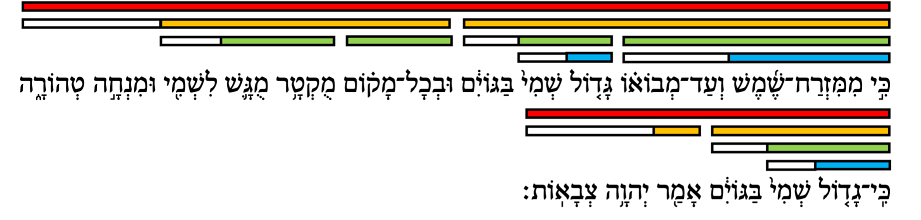
A full segment is one that has a near subordinate domain (a segment governed by a disjunctive in the hierarchy immediately below it) and one or more remote subordinate domains. A fractional segment is a segment with one subordinate near domain. An empty segment is a segment with no subordinate domains.