Verse 2:13
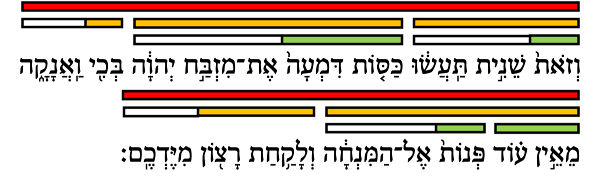
| Now, this second thing you are doing, | |
| spreading tears over the altar of YHVH, | |
| crying and groaning in distress,‡ |
| Because he still does not \ look with favor at this offering, | |
| to receive it favorably from your hand.‡ |
Verse Summary:
In verses 2:10-12 the prophet speaks of the treachery of these Levites in taking unbelieving wives from the peoples around them and then continuing to minister as priests by bringing the offerings. He continues with a different but closely related idea in verses 2:13-16. Not only were they taking wives from outside of Israel and continuing to serve as priests, but they were divorcing their first wives, those of the tribe of Levi. This verse begins to introduce this by stating they were making a great emotional display of sorrow with tears and loud crying when offering a sacrifice because YHVH had not answered their prayers.
Verse Structure:
Both lines of this verse are full, the athnach domain having three subordinate segments and the silluq, two. The first line is an independent verbal clause connected with a disjunctive vav to the previous verse, stating what they were doing; the second line a dependent clause giving the reason for their action.
The initial zaqeph segment in the athnach domain is the direct object and subject-verb. The direct object with a vav precedes the verb indicating a disjunction, a contemporary circumstance, ‘Now, this second thing you are doing.’ The medial zaqeph is an infinitive construct phrase in apposition to the direct object, identifying this second thing, ‘spreading tears over the altar of YHVH.’ The concluding tiphchah segment is a pair of nouns used as an adverbial accusative of manner, ‘weeping and crying in distress.’
The second line states the cause for the first. The zaqeph segment is a verbless clause beginning with the existential particle אין with the attached preposition מן forming the predicate. The subject is the infinitive construct and its object indicated by the preposition אל. ‘Because he still does not \ look with favor at this offering.’. The concluding tiphchah segment is a purpose/result clause consisting of infinitive construct with ל serving as a complement to פנות. The reason/result YHVH would look favorably is to accept the offering of these priests, ‘to receive it favorably from your hand.’
Word Analysis
וְזֹאת֙ — demonstrative pronoun/adjective, fpa, זֶה, this, these + vav; disjunctive accent, pashta; The adjective qualifies the following word שׁנית. This vav is a disjunctive and seems to specify a contemporary circumstance. They were continuing to minister even though they had disqualified themselves by taking wives who were not worshipers of YHVH. And in offering the sacrifices they were doing this second thing as well.
שֵׁנִ֣ית — adjective; fs, שֵׁנִית שֵׁנִי, second; conjunctive accent, munach This word “= again, of similar–not identical–act, or another point in a series” (BDB, p. 1041). The feminine gender can be explained by the fact that infinitives are often treated as feminine. (IBHS, p. 105) The adjective is used substantivally meaning a ‘second thing’. It is then explained by the infinitive clause which follows in the medial zaqeph segment of the athnach domain.
תַּֽעֲשׂ֔וּ — qal imperfective 2mp, עָשָׂה, to do, make; disjunctive accent, zaqeph; The imperfective is a progressive imperfective. The zaqeph separates the main statement, direct object and subject/verb from the appositional clause qualifying the direct object.
כַּסּ֤וֹת — piel infinitive construct, כָּסָה, to cover, clothe, spread over; conjunctive accent, mahpak or disjunctive accent, virtual garshaim; The infinitive construct is used nominally as an appositive qualifying the direct object. As a verbal noun it has its own objects. This verb may have two accusatives, the thing that is used to cover and the thing that is covered. The accent here probably represents a true mahpak rather than a transformed garshaim and unites the infinitive construct with the first of its two accusatives.
דִּמְעָה֙ — noun, fsa, דִּמְעָה, tears; disjunctive accent, pashta; This is the accusative of the thing that is used to cover. The pashta disjoins this accentual unit from the next, the second of the two accusatives of כסות.
אֶת־ — particle, noun indicator, אֵת; maqqeph; This particle introduces the accusative of the thing that is covered. The maqqeph unites the particle with the word at which it points.
מִזְבַּ֣ח — noun, msc, מִזְבֵּחַ, altar; conjunctive accent, munach; This is the object of את and the second direct object of כסות. The mahpak conjoins this construct with its absolute.
יְהוָ֔ה — proper noun, msa, יְהוָה, LORD YHVH; disjunctive accent, zaqeph; This noun is the absolute following מזבח above. The zaqeph ends this middle subordinate segment of the first line specifying the second thing they were doing. The final tiphchah segment of the first line specifies the manner in which they were doing this.
בְּכִ֖י — noun, msa, בְּכִי, weeping; disjunctive accent, tiphchah; This noun is an adverbial accusative of manner which forms an hendiadys with the next noun. The tiphchah marks the third and final subordinate domain of the athnach segment.
וַֽאֲנָקָ֑ה — noun, fsa, אֲנָקָה, crying, groaning in distress + vav; disjunctive accent, athnach; This is another accusative of manner; the previous noun and this one joined by a conjunctive vav could be considered an hendiadys, weeping characterized by loud groans of distress. The English, ‘crying and groaning in distress’ also conveys the same idea. The athnach disjunctive ends the first line.
מֵאֵ֣ין — existential particle of negation, אֵין, there/it is no + preposition; מִן, because of, on account of / some of; conjunctive accent, munach; The מן is causal here and with אין has the idea of ‘because of there not being yet….’ This word, a construct form, is the predicate of the first verbless clause; the subject, the absolute form, is the infinitive פנות. The munach unites this negative predicate with the adverb that follows.
ע֗וֹד — adverb, עוֹד, still, yet, again, besides; disjunctive accent, rebia; This adverb intervenes in the construct-absolute train. The absolute following מאין is פנות. The disjunctive rebia separates this first word unit from the following word, פְּנוֹת. This is very unusual since the expected construct chain is broken by the adverb עוד and emphasized by the accentuation pattern. This forces more stress on the adverb, ‘still or yet.’ The idea is even with all our weeping and groaning in distress, even with all our tears, God is still not accepting our offerings! Why can that be? YHVH will answer them in the next verse.
פְּנוֹת֙ — qal infinitive construct, פּנָהָ, to turn; disjunctive accent, pashta; This word can mean ‘to turn and look at, to regard graciously.’ (BDB p. 815 under meaning 2.c.) This is the absolute after the genitive מאין, which functions as the subject of the verbless clause. The adverb עוֹד intervenes in this broken construct chain. The pashta separates the predicate and subject from the prepositional phrase indicating the object of what is not regarded graciously, the offering of these priests.
אֶל־ — preposition, אֵל, to, for, concerning; maqqeph; The preposition is used with the verb פנה to indicate what is looked at. The maqqeph ties this preposition with its object.
הַמִּנְחָ֔ה — noun, fsa, מִנְחָה, gift, tribute, offering + article; disjunctive accent, zaqeph; The article indicates a particular offering in this case, i.e., the one Malachi has spoken of in verses 1:10, 13, and 2:12. He will use this same word in verses 3:3 and 4 as well. The article here can be translated as a demonstrative. The zaqeph marks the end of the subordinate remote domain of the silluq segment.
וְלָקַ֥חַת — qal infinitive construct, לָקַח, to take, receive, acccept + preposition לְ, to, for; conjunctive accent, mereka; The infinitive construct seems to have a reason/result flavor here complementing the infinitive construct פנות found in the zaqeph segment. YHVH did not look favorably on their offering and as a result he does not receive or accept their offering from them. The mereka connects this word with the following noun.
רָצ֖וֹן — noun, msa, רָצוֹן, goodwill, favor, acceptance, will; disjunctive accent, tiphchah; This noun is an adverbial accusative of manner denoting the manner in which it would be taken or received, i.e., ‘favorably. ’ The tiphchah marks the near subordinate domain of the silluq segment.
מִיֶּדְכֶֽם — noun, fsc, יָד, hand + preposition מִן, from, because of, on account of / some of + 2mp suffix; disjunctive accent, silluq; Note this is the same phrase as used in verses 1:9, 10 and 13. The silluq ends the near subordinate domain of the verse.
Personal Thoughts and Applications:
How effective is our prayer? Does the LORD answer? Do we have to resort to the worn out, old cliché, “God always answers prayer, Sometimes the answer is yes; sometimes, it’s no; sometimes it’s not now.”? Is he granting our requests? These priests were getting a lot of no’s and not now’s! And they were very, very fervent in their prayers. They would weep and wail and cover the altar with their tears. That must have looked very spiritual and been inspirational to others who observed! The issue, however, was themselves. They had defiled the priesthood, the holiness of YHVH, by taking wives outside the faith. And although they knew this was an abomination, they continued to minister as if nothing was amiss. Not only this, as the next verses will make clear they divorced their first wives to do this! YHVH hated this.
YHVH was not answering their prayers as evidenced by the rejection of the sacrifices or more accurately the rejection of their sacrifices was evidenced by the lack of answers to their petitions! The problem certainly could have been defiled sacrifices as seen earlier in this book; but here, the problem was defiled sacrificers.
How effective is our prayer? Does the LORD answer? Maybe, just maybe, the issue is us!
✦✦✦ Home ✦✦✦ Malachi Main Menu ✦✦✦ Discourse 3 Menu ✦✦✦
Verse 2:14

| And [so] you are saying, “Why?”‡ |
| “Because ~ YHVH testifies between you ~ and the wife of your youth \ against whom you have acted treacherously, | |
| although, she is your consort and your covenantal wife.‡ |
Verse Summary:
After YHVH tells these priests that they were making a huge display of mourning during the offering of their sacrifices because he was not accepting the sacrifices and answering their requests, in this verse they ask, “Why?” YHVH’s reply is that they have acted treacherously against their original wives whom he identifies as their consort/companion and the wife of your covenant.
Verse Structure:
The athnach domain is very short, a single fractional tiphchah segment of three Hebrew words or two word-units. It is a verbal clause stating the reply of these priests to YHVH’s statement in the previous verse. ‘And [so] you are saying, “Why?”’
The silluq domain is much longer being YHVH’s reply to that question. It is full, each of the various remote segments being full except the hierarchy V which cannot be subdivided further. This is the typical remote-heavy or right-heavy pattern. The rebia domain of the initial zaqeph segment of this line begins with על, which with the following particle כי, is used as a conjunction introducing a dependent clause. The independent clause is not stated but understood from the previous verse and the first line of this verse. [YHVH was not accepting their sacrifice] because…. The remainder of the rebia domain is the verbal clause, YHVH testifies between you and the wife of your youth. The final pashta segment of this initial zaqeph is a relative phrase qualifying אשׁת נעוריך or the ‘the wife of your youth’, and states, ‘against whom you have acted treacherously.’ The last part of line two is a verbless clause making up the concluding tiphchah segment. It is introduced by a disjunctive vav which indicates in this context an opposing or contrasting idea. In English, the words although or even though convey the idea. ‘although, she is your consort and your covenantal wife.’
Word Analysis
וַאֲמַרְתֶּ֖ם — qal relative vav perfective 2mp, אָמַר, to say, speak + vav; disjunctive accent, tiphchah; This relative vav perfective relates to the imperfective verb תעשׂו in the previous verse which had a progressive sense. Thus, ואמרתם has a progressive sense as well and is consequential to latter. YHVH was not accepting their sacrifices, even with all this display of tears. And (so) they are asking ‘Why?’ The tiphchah marks this as a near subordinate domain of the athnach segment separating the verb from the interrogative.
עַל־ — preposition, עַל, upon, over; maqqeph (עַל) — upon; With the following pronoun the preposition used as a conjunction has the sense of wherefore or why? (BDB, p. 758, under III.) The maqqeph unites this with the following pronoun מָה.
מָ֑ה — interrogative pronoun, מָה, what, how; disjunctive accent, athnach; See above. The athnach ends this very short line, three Hebrew words. This was their response to what YHVH described in the verse before. This follows the pattern set in the second verse of this book; YHVH’s statement, the priest’s questions, then YHVH’s answer.
עַ֡ל — preposition, עַל, upon, over; disjunctive accent, pazer; על is used here with כי as a conjunction in the same sense as above. This begins YHVH’s response to their question. The pazer disjunctive sets apart this preposition which is used as a conjunction to introduce a causal dependent clause from the following conjunction כי. In the athnach segment the priests simply ask, ‘WHY?’ This segment, in answer, begins with the single accentual unit, ‘BECAUSE.’
כִּי־ — conjunction/emphatic particle, כִּי, that, for if, when, indeed; maqqeph; See note above. על כי introduces a dependent clause. The independent clause is unstated but understood from the context of the previous verse and the question posed by the priests. Why was YHVH disregarding their sacrifices given with weeping and cries of distress? [He was not accepting it] because…. While the previous conjunction על introduces the casual idea, the כי itself introduces the clause specifying the cause. The maqqeph unites this word with the following word, the subject of the verbal clause.
יְהוָה֩ — proper noun, msa, יְהוָה, LORD YHVH; conjunctive accent, little telisha; This is the subject of העיד. The little telisha conjunctive unites the subject with the verb which follows.
הֵעִ֨יד — hiphil perfective 3ms, עוּד, testify, bear witness; conjunctive accent, azla; This perfective is an instantaneous perfective. The conjunctive azla unites this with the following prepositional phrase.
בֵּינְךָ֜ — preposition, בֵּין בַּין, between + 2ms suffix; disjunctive accent, geresh; Question: Why does the writer switch from 2mp (plural) addressing priests to the (singular) 2ms here? Perhaps, the reason is that he is speaking to them, not as a group, but to each one individually? Another reason may be the fact the phrase, the wife of one’s youth is more common in the singular than the plural, the pronoun on the first בין was changed to the singular to be in line with this. The geresh, while normally is the subordinate near domain in a rebia segment, in this case functions as a medial remote domain after the pazer because of the following legarmeh domain which now functions as the subordinate near domain of the rebia segment. The geresh separates the first part of the prepositional phrase, from the second part. The preposition בין is repeated before both of its objects ‘between you and (between) the wife of your youth’.
The question that comes to my mind here is why did the authorities of old accent the first part of this line in this manner. Why have three subordinate domains in this rebia segment. When I look at this segment apart from the written accents I see two groupings of ideas: first the conjunction- subject-verb, ‘Because YHVH testifies’; and second, the prepositional phrases explaining this testimony ‘between you and the wife of your youth’. But the accents indicate the authorities understood three groupings: first, the conjunction ‘Because’; second, the subject-verb-first prepositional phrase, ‘YHVH testifies between you’; and then the third, the second prepositional phrase, ‘and (between) the wife of your youth’. Perhaps—and this is conjecture on my part—first, they saw the importance of separating the conjunction to stress this is the answer to the question in line one. Why? BECAUSE! The next disjunction, the geresh, reinforces the seriousness of the issue. The Hebrew preposition בין comes from a word that stresses the interval or space between two things. “To indicate the space separating two objects, bên is repeated” before each of the objects. (TWOT, p. 239) To emphasize this separation—the seriousness of the issue—the geresh disjoins these two objects. The remainder of the rebia segment or the second part of the prepositional phrase is then marked with the optional legarmeh disjunctive.
וּבֵ֣ין׀ — preposition, בֵּין בַּין, between + vav; disjunctive accent, legarmeh; The preposition is repeated here with second object. The legarmeh disjoins this word from the next, its object. See the thoughts on the accents in notes on the preceding word.
אֵ֣שֶׁת — noun, fsc, אִשָּׁה, woman, wife, female; conjunctive accent, munach; This is the second object of the repeated בין. The munach unites this construct with its absolute.
נְעוּרֶ֗יךָ — noun, mpc, נְעוּרִים, youth, early life +2ms suffix; disjunctive accent, rebia; This is the absolute qualifying אשׁת above. This is a genitive of species. (IBHS, p. 152) The wife of one’s youth refers to the wife they first married. Those of us in our western modern culture must recognize the difference between our concept of marriage and the institution as it existed in the prophet’s day. We think of marriage as a contract between two people based primarily on an emotional romantic bond. In the prophet’s time and in many places in the world even today, marriage was contract between two families. The rebia separates this from the next clause, a relative clause.
אֲשֶׁ֤ר — relative pronoun, אֲשֶׁ֤ר, which, what; conjunctive accent, mahpak; The אשׁר introduces a relative clause extending through the end of this verse which qualifies אשׁת נעוריך, ‘the wife of your youth. The mahpak accent, while it might represent a virtual garshaim, probably is just the conjunctive connecting the relative pronoun with the stated subject of the verb.
אַתָּה֙ — personal pronoun 2ms, אַתֶּם, you; disjunctive accent, pashta; The stated subject of the following verb. The use of the pronoun, along with the disjunctive setting this word apart from the verb and its object, seems to add emphasis to this statement. Picture the judge pointing his finger at the accused while stating this.
בָּגַ֣דְתָּה — qal perfective 2ms, בָּגַד, to act or deal treacherously +3fs suffix; conjunctive accent, munach; This seems to be a recent perfective. This is the same word that Malachi used back in verse ten. The munach unites the verb with the following prepositional phrase indicating its object.
בָּ֔הּ — preposition, בְּ, in +3fs suffix; disjunctive accent, zaqeph; The ב here, as in verse ten, indicates the object of the verb. The zaqeph separates the dependent relative from the subordinate clause that follows.
וְהִ֥יא — personal pronoun 3fs, הוּא, הִיא he, she, it + vav; conjunctive accent, mereka; This pronoun with an attached vav is the subject of a verbless clause. The vav is disjunctive introducing a subordinate concessive clause. The mereka unites this word with the next forming a single accentual unit.
חֲבֶרְתְּךָ֖ — noun, fsc, חֲבֶ֫רֶת, consort/wife + 2ms suffix; disjunctive accent tiphchah; This word used only here and comes from the root ,חבר meaning to join together. It “indicates the type of a close relationship which the root ḥābar expresses.” (TWOT, p. 260) This word, along with the next accentual unit, constitute the predicate nominative of the verbless clause. The tiphchah marks the closing subordinate near domain of the second line.
וְאֵ֥שֶׁת — noun, fsc, אִשָּׁה, woman, wife, female + vav; conjunctive accent, mereka; This and the previous word form the predicate nominative of the verbless clause. The mereka unites this construct with its absolute.
בְּרִיתֶֽךָ — noun, fsc, בְּרִית, covenant +2ms suffix; disjunctive accent, silluq; The idea may be that this was the wife allowed by the covenant with Levi, i.e., a wife from the tribe of Levi. It might also refer to a covenant made between the man and wife in their marriage. But included in this is the idea of responsibility. The priest as a husband had covenantal obligations to his wife. See Nehemiah 13:23-29.
Personal Thoughts and Applications:
Not only did these priests marry unbelieving wives outside their tribe and nation, they were divorcing their original wives, ones they had from the beginning, ones from the tribe of Levi. This was an act of treachery against them. They, as Malachi points out, were the wives of their youth, their companions or consorts, and their covenantal wife. This may refer to the fact that they were to take wives from the tribe of Levi according to the covenant, or possibly the covenant of marriage between them. In either case there was a covenant and they had broken it.
The LORD had originally intended marriage to be a partnership between two people, the wife was a helper and a companion. They were to support the priest in his life and ministry. But after sin entered, wives instead became things, possessions of men who were dominant. The priests were remarrying, looking at these foreign wives. Why? The reasons are not given here or elsewhere, but probably not dissimilar to the reasons that exist in our day. They are status symbols, they come into the marriage bringing wealth, they bring sexual pleasure, they form family alliances, and so forth. Why were the priests were doing this? Was it only in Jerusalem or was it more widespread? We do know that this took place in Jerusalem from Nehemiah 13. But in dismissing their former wives, they went against the covenant and incurred YHVH’s displeasure. How like them we are!
✦✦✦ Home ✦✦✦ Malachi Main Menu ✦✦✦ Discourse 3 Menu ✦✦✦
Verse 2:15
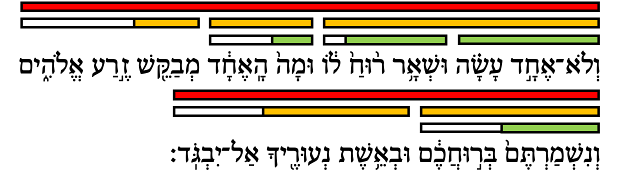
| But no one ever did [this] \ while having a remnant of the Spirit! | |
| Now did why this person [not do this]? | |
| He was seeking godly offspring.‡ |
| Take heed to the Spirit that is yours, | |
| that against the wife of your youth, one not deal treacherously!‡ |
Verse Summary:
Malachi has told the priests that YHVH has not responded to their prayers and sacrifices even when offered with much weeping and wailing because of how they were treating their original wives. Although the writer does not specify exactly how it was that they were dealing treacherously against their original wives, the context makes it clear they were divorcing them. See verse 2:16. Now in this verse, after he tells them that no one who had even a bit of the Spirit had so acted, he exhorts them to pay heed to the Spirit which was theirs so that they did not treat their wives treacherously.
Verse Structure:
Both the athnach and the silluq domains are full. The athnach has three subordinate segments, an initial zaqeph, a medial zaqeph and a final tiphchah. The initial zaqeph segment starts with a verbal clause in its remote rebia domain introduced by a disjunctive vav which is used to contrast this clause with the previous, ‘But no one ever did [this]’. The near pashta domain of the zaqeph is a dependent clause qualifying the subject, ‘while having a remnant of the Spirit!’ The medial zaqeph segment is an independent verbless clause again introduced by a disjunctive vav which interrupts the narrative to ask the question, ‘Now why did this person [not do this]?’ The final tiphchah segment is a verbless clause answering that question, ‘He was seeking godly offspring.’
The silluq domain has two subordinate segments, an initial zaqeph and a concluding tiphchah. Both of these subordinate domains are verbal clauses made in light of the statements in line one. The zaqeph segment begins with a vav relative perfective which has the sense of an imperfective with volitional force; ‘Take heed to the Spirit that is yours.’ The final tiphchah segment is another volitional imperfective which signifies purpose or result in this context, ‘that one does not deal treacherously against the wife of your youth.’
Word Analysis
וְלֹא־ — negative adverb, לֹא לוֹא, no, not + vav; maqqeph; The vav is a disjunctive vav indicating a contrast between what these priests were doing and what a priest who had the Spirit did not do. The maqqeph unites this negative adverb with the following word. The לא is an item adverb here rather than clausal; ‘Not one [person] did [this]’ rather than, ‘One did not do [this].’ This seems to be, at least in English, more emphatic, more exclusive.
אֶחָ֣ד — adjective numeral, אֶחָד, one; conjunctive accent, munach; This is used here as an indefinite pronoun, subject of עשׁה. The munach ties this subject with the verb which follows.
עָשָׂ֗ה — qal perfective 3ms, עָשָׂה, to do, make; disjunctive accent, rebia; This is an indefinite perfective and the context, i.e., the use of לא as an item adverb, here suggests “an emphasis on the uniqueness of an act in the indefinite past.” (IBHS, p. 487) The rebia disjunctive ends this independent verbal clause and separates it from the dependent relative clause which follows.
וּשְׁאָ֥ר — noun, msc, שְׁאָר, residue, rest, remnant + vav; conjunctive accent, mereka or transformed garshaim; The disjunctive vav attached to the noun introduces a clause which specifies a contemporary circumstance. (IBHS, p. 651) The accent could be a virtual garshaim but probably is the mereka uniting the construct with the following absolute.
ר֨וּחַ֙ — noun, fsa, רוּחַ, wind, breath, spirit; disjunctive accent, pashta; The question arises, to what does this refer, literally the wind or breath, the spirit of a person, or the Spirit of God? The option that makes the most sense is the latter, the Spirit of God. Translators vary on this question. For example, the NASB and NKJV both take רוח to refer to the Spirit of God while the NIV, which is an inferior translation for this particular verse in this student’s view, takes it as the human spirit.
ל֔וֹ — preposition, לְ, to, for + 3ms suffix; disjunctive accent, zaqeph; If רוח refers to the Spirit of God, this is a ל indicating possession ‘who had a remnant of the spirit’; if רוח refers to the human spirit, this is a ל of reference. ‘in reference to his spirit’. The former is much more natural and requires fewer unstated assumed ideas. The zaqeph ends the initial subordinate segment of the athnach domain and separates this independent clause from the next independent clause found in the medial zaqeph segment of this line.
וּמָה֙ — interrogative pronoun, מָה, what, how + vav; disjunctive accent, pashta; The מה is used in the sense of why here. This is a verbless clause with only the interrogative, in this case used adverbially, and the following word, the subject of the clause. The vav is disjunctive introducing a new idea by posing a question. The pashta marks the near subordinate domain of the medial zaqeph segment.
הָֽאֶחָ֔ד — adjective numeral, אֶחָד, one + article; disjunctive accent, zaqeph; The article marks this word as definite tying it to its previous occurrence in the rebia segment where it also was the subject. In this instance it would be appropriate to translate the article as a demonstrative, this one or this person, i.e., the person just mentioned. The zaqeph then marks the end of this segment. There is no predicate stated for the subject and it must be supplied from the context. The simplest and most reasonable thing to supply is the verb mentioned just previously in this verse, ‘But no one ever did [this].’ This short clause asks why this is so.
מְבַקֵּ֖שׁ — piel participle msa, בָּקַשׁ, to seek; disjunctive accent, tiphchah; This word begins the third and final subordinate domain of line one, the tiphchah. It is also a verbless independent clause. The subject is not stated, having been identified in the previous two clauses. This predicate use of the participle stresses the state of affairs more so than actual events and explains the reason for the actions just describe. These priests, who had a remnant of God’s Spirit did not divorce their original wives to marry foreign ones because they wanted godly children.
זֶ֣רַע — noun, msc, זֶרַע, sowing, seed, offspring; conjunctive accent, munach; This is the direct object of מבקשׁ. The munach joins this construct with the following absolute.
אֱלֹהִ֑ים — noun, msa, אֱלֹהִים, God, god; disjunctive accent, athnach; The absolute following the construct זרע. The genitive relationship here must be seen in light of the phrase used four verses earlier where these priests were described as marrying the daughter of a foreign god. They were not literal daughters of this false god but women who worshipped this god. So here, offspring of God denotes children who would be worshippers of the true God and not a false one. They wanted children who believed. The athnach ends this line.
וְנִשְׁמַרְתֶּם֙ — niphal vav relative perfective 2mp, שָׁמַר, to be on one’s guard, take heed (BDB, p. 1037 under Niphal 1.) + vav; disjunctive accent, pashta; The vav relative perfective here has the sense of an imperfective with volitional force. (IBHS, p. 534-5) The command follows from the first line.
בְּר֣וּחֲכֶ֔ם — noun, fsc, רוּחַ, wind, breath, spirit +2mp suffix + preposition, בְּ, in; disjunctive accent, zaqeph; Two questions, at least, come to me with this word, first, what is the sense of רוח here. Does it refer to their spirit or does it refer to God’s Spirit. Can it be different than the sense of the word as used in line one? The second question then is what is the sense of the preposition ב in this phrase? The two questions are related; the answer to one affects the other. Concerning רוח, many of the translations which understand the first occurrence of רוח to refer to the Spirit of God do not understand this occurrence to mean the same, NASB and KJV for example. They understand this use to refer to the human spirit, as do all modern translations. To me it seems one should take them to be used in the same sense. What then is the sense of the preposition ב? It can mean ‘to ,in reference to’ and thus to take heed to or in reference to one’s own spirit makes a lot of sense. It would also make sense in the same manner to say one should take heed to or in reference to the Spirit of God. In Exodus 23:13 using the niphal stem, YHVH tells the people to be on their guard concerning or in reference to everything which I have said to you, וּבְכֹל אֲשֶׁר־אַמָרְתִּי אֲלֵיכֶם תִּשָּׁמֵרוּ. Another possibility is the causal use of ב, It could be translated then, Take heed because of the Spirit that is yours—The remnant of the Spirit of God that was with them. It had guided some, these also should listen. The zaqeph marks the end of the remote subordinate domain of the silluq segment and separates the first injunctive found in the intial zaqeph segment with the second in the final tiphchah segment.
וּבְאֵ֥שֶׁת — noun, fsc, אִשָּׁה, woman, wife, female + preposition, בְּ, in + vav; conjunctive accent, mereka; The vav is disjunctive coming before a non-verb. There is a continuity of setting but the action shifts. In the first part of this line, the zaqeph domain, the command was directed to the priests to take heed to the Spirit. Their attention and action focused on their relationship to YHVH. Now this negative injunction directed to the priests focuses on their relationship to their first wives. The preposition ב as with other occurrences of the verb בגד indicate the object of that verb. The mereka conjoins this noun, a construct with its absolute which follows.
נְעוּרֶ֖יךָ — noun, mpc, נְעוּרִים, youth, early life + 2ms suffix; disjunctive accent, tiphchah; A genitive of species. See previous verse where this phase first occurs. The tiphchah falls here on the next to the last accentual unit marking this near domain. It also serves to separate the object of the verb from the subject and verb itself.
אַל־ — negative adverb, אַל, no, not; maqqeph; This negative indicates that the verbal form which follows is volitional. The maqqeph ties it to the verb which follows.
יִבְגֹּֽד׃ — qal jussive 3ms, בָּגַד, to act or deal treacherously; disjunctive accent, silluq; This volitional form should be taken to signify purpose or result in this context. It parallels the idea in the first line. Those who possessed the remnant of the Spirit did not divorce their wives, so here Malachi exhorts these to take heed to the Spirit which was theirs so that or with the result that they did not deal treacherously with the wives of their youth.
Personal Thoughts and Applications:
Marriages between a person of faith and an unbeliever often produce children who do not follow in the faith of the believing spouse. Thus, it was in Malachi’s day; so it is in ours. Children learn from the lives, character and actions of their parents. What are we producing in our marriages? Before one marries, the question should be seriously considered, what do we want our offspring to be?
✦✦✦ Home ✦✦✦ Malachi Main Menu ✦✦✦ Discourse 3 Menu ✦✦✦
Verse 2:16

| “Indeed! [I] hate divorce,” \ says YHVH, the God of Israel, | |
| “and so spreading violence upon one’s garments,” says YHVH of Hosts, |
| Take heed to the Spirit that is yours that you do not deal treacherously! |
Verse Summary:
This verse ends the section dealing with the marriage relationships of the priests. In the last line of the previous verse, he exhorted them to listen to the witness of the Spirit so that they did not deal treacherously against the wives of their youth, i.e., their original wives. Now he concludes by emphatically stating that YHVH hates divorce which pollutes their garments. He again ends with an exhortation to these priests to pay attention to the witness of the Spirit so as not to act treacherously.
Verse Structure:
This verse has many things in common with the previous verse. The accent pattern is very similar; both have an athnach domain with three subordinate segments, and both have a silluq domain with essentially the same exhortation.
The initial zaqeph segment begins with an emphatic כי. The subordinate rebia segment is the statement, the closing pashta segment, the identification of the speaker. The rebia segment is a verbless clause with the subject being clearly understood from the context, ‘Because [I] hate divorce….’ The pashta segment is the statement of who is speaking, ‘says YHVH, the God of Israel,…’ The medial zaqeph segment is a verbal clause epexegetical to the initial statement. Their divorcing of their wives is tantamount to polluting their garments and thus disqualifying them as priests. The concluding subordinate tiphchah segment again states that this is YHVH of Hosts speaking.
The second line is the exhortation based upon the reason stated in the first. It is similar to the silluq domain of the previous verse. This silluq is fractional with just a subordinate tiphchah segment. The first two words are identical to the first two in the previous verse, ‘Take heed to the Spirit that is yours….’ The last part differs in two respects; first, the verbal form shifts from a third singular person in verse fifteen to a second plural in this verse. Second, there is no object stated for the verb in this verse, ‘that you do not deal treacherously,’ while verse fifteen, has a stated object , ‘that one does not deal treacherously against the wife of your youth.’
Word Analysis
כִּֽי־ — conjunction/emphatic particle, כִּי, that, for if, when, indeed; maqqeph; The כי, although it is taken as causal conjunction in most translations is probably emphatic here. It still serves to link this verse with the previous in that it underlines, highlights, and makes bold the seriousness of the command given in the last line of the previous verse.
שָׂנֵ֣א — qal active participle msa שָׂנֵא, to hate; conjunctive accent, munach; This is a predicate use of the participle in a verbless clause. The present continuing state is stressed by the use of the participle here. While the subject is not stated, it is easily understood from the context. (IBHS, p. 624 and GKC, §116 under 5) Thus, most English translations supply the first person singular pronoun as the subject. The munach connects the participle with its direct object.
שַׁלַּ֗ח — piel infinitive construct, שָׁלַח, to send out, send away on a mission; disjunctive accent, rebia; The infinitive construct is used nominally as object of שׂנא. The rebia divides the initial zaqeph segment into two sections; the rebia segment is the content of what is said, the pashta being the statement of who speaks.
אָמַ֤ר — qal perfective 3ms, אָמַר, to say, speak; conjunctive accent, mahpak / virtual garshaim; This is an instantaneous perfective. The accent probably is a mahpak conjunctive rather than a transformed disjunctive garshaim tying the verb with stated subject.
יְהוָה֙ — proper noun, msa, יְהוָה, LORD YHVH; disjunctive accent, pashta; The pashta separates this noun from the word-unit in apposition to it.
אֱלֹהֵ֣י — noun, mpc, אֱלֹהִים, God, god; conjunctive accent, munach; This word and the absolute which follows are in apposition to יהוה. Question: Why add this appositional phrase? Perhaps it is to remind these priests which God they served. Divorce may have been an option for theses wives who were not from Israel; but YHVH, the true God of Israel, hated it. The munach joins this construct with the following absolute.
יִשְׂרָאֵ֔ל — proper noun, msa, יִשְׂרָאֵל, Israel; disjunctive accent, zaqeph; This absolute follows previous construct defining YHVH. The zaqeph marks the end of the initial zaqeph segment of line one and it is the major divider of this first line.
וְכִסָּ֤ה — piel relative vav perfective 3ms, כָּסָה, to cover, clothe, spread over + vav; conjunctive accent, mahpak or disjunctive accent, transformed garshaim; This verb introduces the clause which comprises the subordinate medial zaqeph segment of line one. The type of clause this is affects how the verse is translated. GKC suggests this is an independent relative clause qualifying an unstated pronoun which is the object of the participle שׁנא. “and him that covereth…”. (GKC §155, 5, (b)) This might be viewed as a constituent noun clause used as the object of a verb (from unpublished notes from Professor Don Glenn, Dallas Theological Seminary, given in class 1972-2973). This medial zaqeph segment would then be a second object of the participle שׂנא and translated much the same as the first option.. YHVH hates divorce and the one who spreads violence upon his garments.
A third possibility is that this is a relative vav perfective following a participle. In this case, it would be used to “describe a consequent situation, whether temporal…or logical.” (IBHS, p. 535) Taken in the context of these priests and their ministry of offering the sacrifices and making intercession for the people, their divorcing their original wives was an act of treachery and tantamount to covering their priestly robes with violence or wrong disqualifying them from service. Not only were they sanctified, their priestly garments were as well. See Exodus 28. The vav relative perfective represents an imperfective action. This seems to fit the context much better than the first two options. The accent here is probably a mahpak conjunctive uniting the verb with its object rather than a virtual garshaim. It should be noted that this was the same word used to describe the actions of these priests in spreading their tears upon the altar appearing to be sincere and passionate in their prayers. YHVH uses it to describe what they were symbolically spreading on their robes when they divorced their first wives to marry foreign unbelieving wives.
חָמָס֙ — noun, msa, חָמָס, wrong, violence; disjunctive accent, pashta; This word can mean physical violence, “but also wrong , incl. injurious language, harsh treatment.” (BDB, p. 329) This seems to be the idea here. The pashta marks this near subordinate segment of this zaqeph segment and separates the direct object, i.e., what is being spread, from the prepositional phrase indicating upon what it is spread.
עַל־ — preposition, עַל, upon, over; maqqeph; The preposition indicates what they were spreading violence or wrong upon. The maqqeph unites the preposition with its object.
לְבוּשׁ֔וֹ — noun, msc, לְבוּשׁ לְבֻשׁ, garment, clothing + 3ms suffix; disjunctive accent, zaqeph; This is a reference to the priestly garments worn by the Levites. The zaqeph ends this subordinate remote domain of the athnach segment and separates what is said from the identification of the speaker in the tiphchah segment.
אָמַ֖ר — qal perfective 3ms, אָמַר, to say, speak; disjunctive accent, tiphchah; This perfective is an instantaneous perfective. The tiphchah marks the subordinate near domain of the athnach and serves to separate the verb from the stated subject.
יְהוָ֣ה — proper noun, msc, יְהוָה, LORD YHVH; conjunctive accent, munach; The munach unites the construct with the absolute qualifying it.
צְבָא֑וֹת — noun, mpa, צָבָה, host, army, war, warfare; disjunctive accent, athnach; The athnach ends the first line.
וְנִשְׁמַרְתֶּ֥ם — niphal perfective 2mp, שָׁמַר, to be on one’s guard, take heed + vav; accent, mereka; As in the previous verse the vav relative perfective has the sense of an imperfective with volitional force. The mereka joins the verb with the prepositional phrase qualifying it. See the notes on this phrase in verse 2:15.
בְּרוּחֲכֶ֖ם — noun, fsc, רוּחַ, wind, breath, spirit +2mp suffix + preposition, בְּ, in; disjunctive accent, tiphchah; See the notes on this phrase in the previous verse. The tiphchah marks the near subordinate domain of the silluq segment.
וְלֹ֥א — negative adverb, לֹא לוֹא, no, not + vav; conjunctive accent, mereka; See verse 2:15 where the same construction is used. The munach unites the adverb with the verb which follows.
תִבְגֹּֽדוּ — qal imperfective 2mp, בָּגַד, to act or deal treacherously; disjunctive accent, silluq; The negative is לא rather than אל. With second person לא is also used in the same sense. (IBHS, p. 567) This should be taken as a jussive and seen to signify purpose or result as in verse 2:15.
Personal Thoughts and Applications:
Malachi is telling these priests that their relationship with their wives either validates their ministry or disqualifies it. It did not matter how sincere and emotional their ministry was, if they acted wrongly marrying women that did not share their faith and/or divorcing their first wives, he was not listening and would not answer their requests.
How sincerely have I prayed for something while refusing to acknowledge sin in my life, problems with my marriage that I have refused to deal with? Is there a relationship?
✦✦✦ Home ✦✦✦ Malachi Main Menu ✦✦✦ Discourse 3 Menu ✦✦✦
Verse 2:17

| You have been wearying YHVH with your words. | |
| But you are saying, “How have we wearied [you]?” |
| When you say, \ “Everyone who does evil is good in the eyes of YHVH \ since in them he delights.” | |
| or, “Where is the God of judgment?” |
Verse Summary:
This verse begins a new section which extends through chapter three, verse six. Employing the same literary device with which he started this book, the prophet, speaking for YHVH makes a statement. In the first line he says they have wearied YHVH with their words. The priests then respond asking how this could be true. In the second line YHVH explains they do this when they say either YHVH has started blessing evil or he is gone and not a God of justice any longer.
Verse Structure:
Both the athnach and the silluq segments are full comprised of two subordinate domains. The first line contains YHVH’s indictment in the zaqeph segment and the response of the priests in the tiphchah. The zaqeph segment of the athnach domain is an independent verbal clause. The tiphchah segment is also an independent verbal clause but is successive and subordinate being a contrast to what YHVH says.
The second line is the beginning of YHVH’s rebuttal. The silluq segment is a dependent clause with an unexpressed but understood independent clause being equivalent to the first part of line one, ‘[You have been wearing YHVH with your words] when you say….’ The zaqeph segment of this line is full with three subordinate domains. The initial subordinate domain, the rebia segment, contains the verbal statement, ‘when you say’, i.e. in your saying/by your saying, etc. What follows in this line is the object of that infinitive construct, the content of what they were saying. The subordinate medial rebia segment and the pashta segment of the zaqeph domain form one statement. The tiphchah segment is another alternate statement.
The medial rebia segment is a verbless clause, ‘Everyone who does evil is good in the eyes of YHVH’; the pashta segment is a verbal clause joined by a vav disjunctive and is epexegetical explaining why this is seen as true, ‘for in them he delights.’ The closing tiphchah segment of line two is connected by the coordinating conjunction או which presents an alternative. It is a verbless interrogative clause, ‘Where is the God of Justice?’
Word Analysis
הוֹגַעְתֶּ֤ם — Hiphil perfective 2mp, יָגַע יָגֵעַ, to cause to grow weary, toil; conjunctive accent, mahpak or disjunctive accent, virtual garshaim; This is a persistent present perfective; they did it in the past and it continues in the present. The accent on this word could represent a virtual garshaim but is probably a mahpak conjunctive joining the subject/verb with the direct object. If it does represent a virtual garshaim, then it separates these two.
יְהוָה֙ — proper noun, msa, יְהוָה, LORD YHVH; disjunctive accent, pashta; This is the direct object of הוגעתם. The pashta marks this near subordinate domain and serves to separate the subject/verb and the direct object from the adverbial prepositional phrase.
בְּדִבְרֵיכֶ֔ם — noun, mpc, דָּבָר, word, speech, message + 2mp suffix + preposition, בְּ, in; disjunctive accent, zaqeph; The ב indicates the means or instrument with which they wearied YHVH. The zaqeph ends this subordinate segment which is an independent verbal clause beginning a new section of this message by Malachi
וַאֲמַרְתֶּ֖ם — qal relative vav perfective, 2mp, אָמַר, to say, speak + vav; disjunctive accent, tiphchah; The relative vav perfective again indicates a logical connection, a contrast or opposition, with the preceding clause. The sense is progressive or perhaps specific future as in verse 1:7. The tiphchah falls on this word rather than במה separating the verb, ‘But you are saying…’, from its object, i.e., what they were saying.
בַּמָּ֣ה — interrogative pronoun, מָה, what, how + preposition, בְּ, in; conjunctive accent, munach; ‘in what way, how?’ The munach unites the prepositional phrase with the subject/verb.
הוֹגָ֑עְנוּ — Hiphil perfective 1cp, יָגַע יָגֵעַ, to cause to grow weary, toil; disjunctive accent, athnach; The object of the verb is an understood you. As with the first occurrence of this word above, it is a persistent present perfective. The athnach marks the end of this segment or line one.
בֶּאֱמָרְכֶ֗ם — qal infinitive construct, אָמַר, to say, speak + 2mp suffix + preposition, בְּ, in; disjunctive accent, rebia; This is a nominal use of infinitive construct used as the object of the preposition ב. The suffix is subjective. The preposition is used temporally or possibly a causal use with the infinitive construct. This is similar to the construction in verse 1:7. In that verse, the verb included more the idea of what they were saying in or by their actions; here it seems to be more verbal. The rebia segment, one word, באמרכם, begins the initial zaqeph section of the second line. It is a dependent verbless clause with an unstated dependent clause. The tiphchah segment of line one ended with the question, ‘How have we wearied [you]?’ Line two answers that question ‘ [You have been wearying me] when you say….’ The rebia separates this verbal noun from its object what they were saying which comprises the rest of this verse.
כָּל־ — noun, msc, כֹּל, all, every; maqqeph; This adjective used substantivally is the subject of verbless clause making up the object of the infinitive construct. This begins the content of what they were saying. There are two statements, one in the remaining part of this zaqeph segment and the second in the concluding tiphchah segment. The maqqeph unites this construct with the following participle.
עֹ֨שֵׂה — qal participle msa, עָשָׂה, to do, make; conjunctive accent, azla; This is a substantival use of participle as a partitive genitive following כל. The azla connects the participle with its object.
רָ֜ע — adjective msa, רַע, evil, bad; disjunctive accent, geresh; The adjective used substantivally is the object of the previous participle. The geresh separates the phrase כל־עשׂה רע, ‘all who do evil’, which is the subject of this verbless clause from the predicate adjective which follows.
ט֣וֹב׀ — adjective msa, טוֹב, pleasing, good agreeable; disjunctive accent, legarmeh; This is the predicate adjective in a verbless clause. The legarmeh disjunctive acts as the subordinate near disjunctive in this rebia segment and it serves to separate the predicate adjective from the prepositional phrase which qualifies it.
בְּעֵינֵ֣י — noun, mdc, עַיִן, eye + preposition, בְּ, in; conjunctive accent, munach; the prepositional phases used adverbially specifying in whose sight something is considered to be good. The munach unites this construct with the following absolute.
יְהוָ֗ה — noun, msa, יְהוָה, LORD YHVH; disjunctive accent, rebia; The absolute is a genitive of inalienable possession (IBHS, p. 145) following עיני. The rebia marks the end of this medial rebia segment of the zaqeph domain. It marks the end of the first independent clause stating what these priests were saying.
וּבָהֶם֙ — preposition, בְּ, in; + 3mp suffix + vav; disjunctive accent, pashta; This prepositional phase begins the last subordinate segment of the zaqeph, the pashta segment. It is a verbal clause introduced by a disjunctive vav. This clause explains why the priests were saying that those who do evil were good in YHVH’s eyes.
It is crucial to catch the flavor of these statements. It is dripping with sarcasm. Of course, these priests do not really think YHVH rewarded evil and punished the righteous. In fact, their great hope was that YHVH would reestablish the Kingdom. Look at the very next verse in this section verse 3:1—the English chapter divisions are really bad here!—where they are looking for the messenger of the covenant to return, to punish evil, to restore righteousness. They thought themselves to be the righteous ones, and the surrounding nations to be the unrighteous. But the reality was that others were prospering, others who disregarded the Mosaic laws and worshipped false gods, i.e., the Persians and their allies who were in power and ruled. This reflected the common belief was that if one was righteous, YHVH would bless materially and those that were not so blessed were in some way under his judgment. They thought, something is wrong here! YHVH needs to return. He needs to put them down and restore us, the true worshippers of YHVH! And so, the sarcasm. Maybe they thought perhaps this would goad YHVH into action.
The pashta falls on the prepositional phrase which is placed first in this clause and separating it from the subject and verb giving it a bit of emphasis by these priests, ‘since IN THEM he delights.’
ה֣וּא — personal pronoun 3ms, הוּא, הִיא he, she, it; conjunctive accent, munach (הוּא) — he, she, it; stated subject of verb. The munach connects this pronoun with the verb which follows.
חָפֵ֔ץ — qal perfective 3ms, חָפֵץ, to delight in; disjunctive accent, zaqeph; The perfective is a durative stative perfective. It should be noted that YHVH has already stated in verse 1:10 that he takes no delight חפץ (noun form) in them, these priests. The zaqeph marks the end of first part of line two.
א֥וֹ — conjunction, אֹו, or; conjunctive accent, mereka; This conjunction joins two alternatives. (IBHS, p. 654) The first alternative is stated in the independent clause found in the last two subordinate domains of the zaqeph segment, this second alternative is in the interrogative clause in this concluding tiphchah segment. Either YHVH was blessing the evil person, or he was not there and not judging them. The mereka connects this short conjunction with the following noun.
אַיֵּ֖ה — interrogative adverb, אַיֵּה, where?; disjunctive accent, tiphchah; The interrogative implies YHVH was not present? The tiphchah accent necessarily falls on this next to the last accentual unit of the segment.
אֱלֹהֵ֥י — noun, mpc, אֱלֹהִים, God, god; conjunctive accent, mereka; This is the subject of the verbless clause. The mereka unites the construct noun with its absolute.
הַמִּשְׁפָּֽט — noun, msa, מִשְׁפָּט, judgment (BDB, p. 1048), justice, ordinance, custom, manner (TWOT, p. 948) + article; disjunctive accent, silluq; This is an attributive genitive, a God who is characterized by משׁפט, judgment or justice. This word, most often translated as judgment has a wide range of meanings. See the full discussion of this word in TWOT.
“An analysis of all uses in the Bible turns up at least thirteen related, but distinct, aspects of the central idea, which if to be rendered by a single English word with similar range of meaning, ought by all means to be the word ‘justice.’”
They did not think it was right that these other lawless nations were prospering. The article with the adjective could almost be translated as a demonstrative, strengthening the definiteness of ‘the God of justice.’Where was the just God who was supposed to judge sin and reward the righteous? they sarcastically asked. The silluq marks the end of this verse.
Personal Thoughts and Applications:
Too often those of us who are conservative believers wonder to ourselves, why hasn’t God stepped in and judged the wicked? They seem to prosper and do just fine, evil seems to rule, good suffers! Those words are what these priests uttered, possibly aloud, but certainly to themselves. So we pray that our Lord will soon return and set things aright. What we fail to realize, just as these priests did, is that he will, but this setting things right will begin with us. We are certainly not the paragon of what is just, good and proper. The church today is far from what should be for we are living in the last days, in the era of the Laodicean church. He is indeed coming. It is not far off. He will judge, but it will begin with us!
What did the LORD say about their thoughts? He said he was weary of it! He will soon answer as he tells them in the verses.
✦✦✦ Home ✦✦✦ Malachi Main Menu ✦✦✦ Discourse 3 Menu ✦✦✦
Verse 3:1

| “Behold! I am about to send my messenger; | |
| and he will clear the way before me.‡ |
| And (then) suddenly he will come to his Temple, § the Lord whom you are seeking; \ even the messenger of the covenant in whom you delight. Behold, he is coming!” | |
| says YHVH of Hosts.‡ |
Verse Summary:
In verse 2:17, the first verse of this section, YHVH told these priests he was weary of hearing them complain about the wicked going unpunished and asking, ‘Where is this God of justice?’ In this verse he tells them his coming is imminent. He is just about to send his messenger, a forerunner to prepare the way. Then, after that, suddenly, the Lord, one they have been seeking, the messenger of the covenant, the one in whom they delight will come to the Temple of the Lord.
Verse Structure:
As is normal, the verse has two parts, but in this verse the athnach domain is much shorter, six Hebrew words, than the silluq, 18 Hebrew words. The first line, the athnach segment, is divided into two independent clauses, an initial zaqeph domain and a concluding tiphchah domain. The zaqeph domain is a verbless clause introduced by הנהי stressing the immediacy or sureness of YHVH’s actions, ‘Behold! I am about to send my messenger.’ The tiphchah domain is an independent verbal clause which is logically successive to the first, ‘and he will clear the way before me.’
The silluq domain of this verse is also divided into two parts, an initial zaqeph domain and a closing tiphchah. The zaqeph segment is full having an initial full rebia domain and a concluding fractional pashta domain. The opening geresh domain of this rebia segment is an independent clause beginning with an adverb with a disjunctive vav. There is a shift in the participants. In the first line YHVH states he will send a messenger to clear the way before he comes. In the second line the focus is not on the preparatory messenger but on the coming of YHVH. From the New Testament, it is clear this is the Messiah, Jesus Christ our Lord. The clause in this initial geresh segment states, ‘And (then) suddenly he will come to his Temple.’ The clause which follows in the closing legarmeh domain of the rebia segment is the stated subject of the verb יבוא, ‘he will come.’. The clause consists of a noun followed by a relative clause, ‘the Lord whom you are seeking.’ The pashta domain comprising the remainder of this zaqeph segment begins with the noun phrase ומלאך הברית, ‘the messenger of the covenant’ with an attached vav . This vav is a phrasal vav used connecting this word to the noun האדון, ‘the Lord’; it is explicative or emphatic. (IBHS, p. 649). This is to say, the Lord who will suddenly come to his temple is ‘even’ the messenger of the covenant! This noun phrase ומלאך הברית is then followed by the relative clause ‘in whom you delight’ just as the noun האדון was followed by ‘whom you are seeking’. The pashta domain then concludes with the independent clause הנה־בא, ‘Behold, he is coming! ’ The line ends with the concluding tiphchah domain containing the formula, ‘says YHVH of Hosts.’
Word Analysis
הִנְנִ֤י — presentative particle, הִנֵּה, behold, see, now + 1cs suffix conjunctive accent, mahpak or disjunctive accent, virtual garshaim; The presentative particle implies immediacy. The pronominal suffix is the subject of the following participle. The mahpak conjunctive probably represents a transformed garshaim setting the particle and the subject of this verbless clause apart from the predicate participle.
שֹׁלֵחַ֙ — qal participle msa, שָׁלַח, to send out, send away on a mission; disjunctive accent, pashta; This is a predicate use of the participle in a verbless clause. The pasta separates the subject and predicate from the object of the verb.
מַלְאָכִ֔י — noun, msc, מַלְאָךְ, messenger +1 cs suffix; disjunctive accent, zaqeph; This is exactly the same word used in verse one, but here it definitely means my messenger, and not a proper name. It is prophetic of John the Baptist in a near fulfillment in reference to the first coming of our Lord, but ultimately it is a reference to Elijah—See verses 4:5-6.—who comes before the second coming, which is primarily in view here. The zaqeph marks the end of this clause.
וּפִנָּה־ — piel, relative vav perfective 3ms, פּנָהָ, turn away, turn out of the way, to clear + vav; maqqeph; This verbal clause is successive to the prior one. The maqqeph unites the verb-subject with the object of the verb which follows. The relative vav perfective picks up the imminent future idea from the first clause of this line.
דֶ֖רֶךְ — noun, msa, דֶּ֫רֶךְ, way, road, distance, journey, manner; disjunctive accent, tiphchah; This is the direct object of ופנה. The tiphchah marks the closing segment of this line and serves to set this word-unit apart the last adverbial prepositional phrase.
לְפָנָ֑י — noun, mpc, פָּנִים, face + לְ, to, for + 1cs suffix; לְפָנָי is a frozen noun-preposition meaning before (IBHS, p. 221); disjunctive accent, athnach; The athnach marks the end of line one which deals with the coming of the messenger. The second line then concerns the coming of YHVH.
וּפִתְאֹם֩ — substantive, פִתְאֹם, suddenness as adverbial accusative, suddenly; + vav; conjunctive accent, little telisha; The vav attached to the non-verbal form indicates it is vav disjunctive. Here there is a change in participants. The focus changes from the messenger who is sent to the one he comes before. The little telisha connects this adverb with the verb that follows.
יָב֨וֹא — qal imperfective 3ms, בּוֹא, ‘to come go’; conjunctive accent, azla; This is a specific future use of the imperfective. The azla connects the preceding word unit to the next word unit.
אֵל־ — preposition, אֵל, to, for, concerning; maqqeph; This preposition indicates the destination to which the Lord was coming. A maqqeph connects the preposition with its object.
הֵיכָל֜וֹ — noun, msc, הֵיכָלֹ, temple, palace + 3ms suffix; disjunctive accent, geresh; The pronoun on this word identifies for the reader the subject. Whose temple is it? It is YHVH’s. The geresh, normally marking a near subordinate domain, in this instance marks a subordinate remote domain and divides of this rebia segment into two parts. This part is the predicate of an independent verbal clause; the stated subject is found in the subordinate near domain.
הָאָד֣וֹן׀ — noun, msa, אָדוֹן, lord, master + art; disjunctive accent, legarmeh; This word is the subject of יבוא. This term can be used of God and of a human lord or master as well. Here it combines both ideas. The use of the article marks this word as definite pointing to a particular lord. For the priests this could be none other than the promised one to come who would rule on David’s throne and establish the kingdom. We know from the New Testament this refers to the Messiah, our Lord who is fully man and perfectly divine. The legarmeh disjunctive serves to separate this noun from the relative clause qualifying it. He will come into his Temple. Who is he? He is the Lord, the one they are seeking.
אֲשֶׁר־ — relative pronoun, אֲשֶׁר, who, which, what, whom; maqqeph; The pronoun introduces a relative clause. The referent is האדון, and the relative pronoun is the object of the participle מבקשׁים. The maqqeph unites the pronoun with the following word.
אַתֶּ֣ם — personal pronoun 2mp, אַתֶּם, you; conjunctive accent, munach; This is the subject of the following participle. It is a reference to the priests who have just asked, איה אלהי המשׁפט, Where is the God of justice? The munach connects this word-unit with the following participle.
מְבַקְשִׁ֗ים — piel participle mpa, בָּקַשׁ, to seek, require, desire; disjunctive accent, rebia; This is a verbal use of the participle stressing an on-going state. These priests were seeking this. They wanted the Messiah to come and reestablish the kingdom. The subject is אתם, in reference to the priests to whom the prophet was speaking. The rebia marks the end of the initial segment of the zaqeph which is the first part of the description of the subject, the one that is coming suddenly to his temple. He is the Lord, whom they were seeking. The final part of this zaqeph domain is the following pashta segment which is the last part of the description of the one that was coming.
וּמַלְאַ֨ךְ — noun, msc, מַלְאָךְ, messenger + vav; conjunctive accent, azla; The vav is a phrasal vav used connecting this word to the noun האדון, ‘the Lord’; it is explicative or emphatic. (IBHS, p. 649). This is to say, the Lord who will suddenly come to his temple is ‘even’ the messenger of the covenant! This noun phrase ומלאך הברית is then followed by the relative clause ‘in whom you delight’ just as the noun האדון was followed by ‘whom you are seeking.’ The azla connects this word in construct with the following absolute.
הַבְּרִ֜ית — noun, fsa, בְּרִית, covenant + art; disjunctive accent, geresh; The word is the absolute or genitive following ומלאך. Several questions arise at this point. What kind of genitive is this? This certainly seems to be in a general sense an objective genitive, (TWOT, p. 146), that is, the covenant is the object of the verbal action of the construct noun in some manner. The construct announces, makes, brings, mediates, establishes or in some way acts in relation to this covenant. Yet, what is the precise relationship? Secondly, what covenant is in view here? Is this the covenant with Levi previously mentioned; See verse 2:3? Is this the Mosaic covenant; See verse 4:4? Or is it another covenant, such as the New Covenant found in Jeremiah 31:31? These priest surely would have been familiar with Jeremiah.
In reflecting upon these questions and the text in Malachi, it appears to me that these priests were looking for the reestablishment of the Davidic kingdom under the coming of the promised one. In this kingdom, I believe these priests expected to be rewarded and placed in positions of power for they were the teachers and experts in the Law. They felt that they were the righteous, the rest of the nations were the unrighteous lawless peoples. Being familiar with Jeremiah, they looked for the Messiah to come and reestablish this kingdom and the new covenant. Their view of this covenant would have, of course, been very similar to the old Mosaic covenant; they would have had no concept of what our Lord, the Messiah would do to establish this new covenant. They would have had no inkling of the mystery of the church. But they knew Messiah was coming with a new covenant and this is the Lord they were seeking. They wanted him to come so their fortunes would be changed.
אֲשֶׁר־ — relative pronoun, אֲשֶׁר, who, which, what, whom; maqqeph; The referent is מלאך הברית; the relative pronoun itself is the object of the participle חפצים. The maqqeph joins this pronoun with the following pronoun.
אַתֶּ֤ם — personal pronoun 2mp, אַתֶּם, you; conjunctive accent, mahpak; This is the subject of the following participle. It is a reference to the priests to whom Malachi is speaking. The mahpak is a mahpak since there is already a geresh domain in this pashta segment and geresh does not repeat. The mahpak links this word-unit to the following participle.
חֲפֵצִים֙ — qal participle mpa, חָפֵץ, to delight in; disjunctive accent, pashta; This is a verbal use of the participle stressing an on-going state. The pashta marks the subordinate near domain of the zaqeph segment and the end of the second statement of the one who is coming. ‘And (then) suddenly he will come to his Temple, the Lord whom you are seeking; even the messenger of the covenant in whom you delight.’ The last two words of this zaqeph segment form another independent clause, ‘Behold! He is coming!’
הִנֵּה־ — presentative particle, הִנֵּה, behold, see, now; maqqeph; The maqqeph ties this word with the following participle.
בָ֔א — qal participle msa, בּוֹא, to come go; disjunctive accent, zaqeph; This again is a predicate use in verbless clause. The subject is unstated but understood from previous clause. The zaqeph marks the end of this complex statement. The fact that this phrase is repeated is importatnt. It is the major idea. If there is one thing YHVH wanted these priests to grasp is that the one they were looking for IS COMMING!! This phrase also serves to introduce the idea presented in the next verses, namely, that when he comes he will come to purify and refine the priesthood.
אָמַ֖ר — qal perfective 3ms, אָמַר, to say, speak; disjunctive accent, tiphchah; An instantaneous perfective. The tiphchah marks this domain of the silluq segment. It is the declaration of the speaker.
יְהוָ֥ה — proper noun, msc, יְהוָה, LORD YHVH; conjunctive accent, mereka; The accent conjoins this word with the absolute that follows.
צְבָאֽוֹת׃ — noun, mpa, צָבָה, host, army, war, warfare; disjunctive accent, silluq; The silluq ends the line; the soph pasuq the verse.
Personal Thoughts and Applications:
The priests bemoaned the fact that YHVH had not yet come and set up his kingdom, that the wicked prospered (verse 2:17) and it was a tiresome thing to serve as an officiating priest offering the sacrifices (verse 1:13). Now he tells them he is about to send his messenger, then he will come to the Temple! The next few verses , however, will make it very clear that he is coming to judge them and purify the priesthood. Not what they were expecting!
I wonder, how many conservative believers today do the same thing. Do we really want him to come and judge? Where will he begin? With whom will he start? Malachi will tell us!
✦✦✦ Home ✦✦✦ Malachi Main Menu ✦✦✦ Discourse 3 Menu ✦✦✦
Verse 3:2

| But who is going to be the one enduring the day of his coming? | |
| Or who is going to be the one (left) standing when he appears?‡ |
| because he is like the fire of a refiner | |
| or the alkali soap of a fuller.‡ |
Verse Summary:
This verse questions the expectations of these religious leaders. They asked, where was YHVH, meaning that he should come back and set up the promised kingdom. Note that both Haggai and Zechariah years earlier had prophesied of YHVH’s return to judge the nations and establish his kingdom. See Haggai 2:6-9, 21-23 and Zechariah 14. It had not yet taken place, nor did it seem to be close. They wanted this to happen. But Malachi by these questions in the first line is saying, “Wait a minute now! Do you really think you want this? You will not escape his judgment when he comes! No one will. Do not think you will be left standing when this happens.” Then he explains, that when he returns, he will be like an extremely hot furnace fire burning out all impurities in the metal or like a caustic soap that bleaches out every stain. The implication is clear; you are not exempt from this.
Verse Structure:
Both the athnach and the silluq segments are divided into two major domains. In the athnach segment each domain is a verbless rhetorical question. The zaqeph and the tiphchah are parallel with the ideas intensifying each other. The silluq domain is a causal dependent clause giving the reason for the questions and their implied answers. It is a comparison clause with the zaqeph giving one comparison and the tiphchah another.
Word Analysis
וּמִ֤י — interrogative pronoun, מִי, who? +vav; conjunctive accent, mahpak or disjunctive accent, virtual garshaim; The is a disjunctive vav introducing a contrasting idea from previous verse. The question is rhetorical not asking for an answer so much as emphasizing the expected answer that no one will endure the (second) coming of Messiah. This is in contrast to the idea that these priests professedly looked for and wanted the Messiah to come. The question is, when he comes, who will endure? The expected answer, no one! The pronoun is the subject of the verbless clause which makes up this zaqeph segment. The mahpak could be a transformed garshaim, yet here, if this segment parallels the tiphchah in accentuation, then it probably is a conjunctive mahpak uniting subject and predicate nominative.
מְכַלְכֵּל֙ — pilpel participle msa, כּוּל, sustains, endures; disjunctive accent, pashta; The pilpel stem is a minor stem a minor stem being a morphemic variant of the piel. (IBHS, p. 360) Concerning this word TWOT states, “The primary meaning of this root is ‘to contain as does a vessel.’… a logical extension of the above meanings are those which express the possibility or impossibility of enduring (or containing) something”. (TWOT, p. 432) This is an independent relative participle in a verbless clause functioning as a predicate nominative. (IBHS, p. 621) The subject is מי. The sense is future in connection with previous verse. The pashta separates the subject-verb from the object of the verb similarly to the tiphchah segment of this line.
אֶת־ — particle, noun indicator, אֵת; maqqeph; This particle indicates the definite object of the participle מכלכל. The maqqeph unites the particle with the noun to which it points.
י֣וֹם — noun, msc, יֹום, day; conjunctive accent, munach; This is the object of the participle, the thing that is endured. The munach connects the construct with its absolute.
בּוֹא֔וֹ — qal infinitive construct, בּוֹא, to come, go + 3ms suffix; disjunctive accent, zaqeph; The infinitive construct is a temporal genitive after יום; i.e., the day when he comes. The suffix represents the subject of the verbal action. The zaqeph marks the end of this segment.
וּמִ֥י — interrogative pronoun, מִי, who? +vav; conjunctive accent, munach; This word begins the tiphchah segment. Although the preceding clause was not negated, the use of the interrogative pronoun implied the answer was a negative. The vav attached to the pronoun here specifies an alternative. It introduces a parallel statement, and to intensifies the idea made in the zaqeph segment. As above, this is the subject of a verbless interrogative clause. The mereka unites subject and predicate nominative.
הָעֹמֵ֖ד — qal participle msa, עָמַד, to stand + art; disjunctive accent, tiphchah; This is another independent relative participle as is indicated by the presence of the article, ‘the one standing.’ used as the predicate nominative to מי. The tiphchah marks this segment and also serves to separate the subject and predicate nominative from the temporal prepositional phrase which ends this line.
בְּהֵרָֽאוֹת֑וֹ — niphal infinitive construct, רָאָה, to present oneself, to appear + 3ms suffix + preposition, בְּ, in; disjunctive accent, athnach + auxiliary accent, metheg; This is a temporal use of ב. The suffix represents the subject of the verbal action of the infinitive construct. The athnach marks the end of the first line.
כִּֽי־ — conjunction/emphatic particle, כִּי, that, for if, when, indeed; auxiliary accent, metheg; The כי functions as a causal conjunction introducing a verbless dependent clause. The maqqeph unites this conjunction and the following pronoun into a single word-unit.
הוּא֙ — personal pronoun 3ms, הוּא, הִיא he, she, it; disjunctive accent, pashta; This pronoun is the subject of the verbless clause. The pashta separates the pronoun subject from that to which it is compared in the first half of this compound comparison.
כְּאֵ֣שׁ — noun, fsc, אֵשׁ, fire + preposition כְּ, the like of, like, as; conjunctive accent, munach; This forms the predicate nominative of the verbless clause. The munach unites the construct with its absolute.
מְצָרֵ֔ף — piel participle msa, צָרַף, to refine; disjunctive accent, zaqeph; The participle is used as a substantive, the absolute or genitive following כאשׁ. This could be a possessive genitive or more likely described as a genitive of mediated object, the fire ‘used by a refiner’. (IBHS, p. 146) The zaqeph marks the end of the first subordinate segment of the silluq domain.
וּכְבֹרִ֖ית — noun, fsc, בֹּרִית, lye, alkali, potash, soap + preposition כְּ, the like of, like, as +vav; disjunctive accent, tiphchah; The vav, as above, specifies an another alternative comparison to the one in the zaqeph segment of this line. It is the second part of a compound comparison. The subject הוא is understood from the zaqeph segment. The tiphchah accent necessarily falls here replacing a conjunctive which otherwise would be found.
מְכַבְּסִֽים׃ — piel participle msa, כָּבַס, to wash, cleanse; disjunctive accent, silluq; A substantival use as above. As with מצרף, this probably a genitive of mediated object. The silluq ends the verse.
Personal Thoughts and Applications:
I am convinced that the conservative church, at least in our country, is much like these priests. We talk about wanting the rapture to take place and our Lord to return but are we really ready. Will he find us prepared for his coming? For when he returns for us, we will all have to stand before him at his judgment seat. Are we ready to answer him for what we have done and how we have lived? When he comes, purification will start with those who claim at least to be his followers. It will be harsh and intense. Impurities in the church will be burned away; stains will be blotted out! Are we really ready?
✦✦✦ Home ✦✦✦ Malachi Main Menu ✦✦✦ Discourse 3 Menu ✦✦✦
Verse 3:3

| For he will sit as a refiner and purifier of silver | |
| for he will cleanse the sons of Levi; he will refine them | |
| as gold and as silver.‡ |
| so that they might be for YHVH | |
| presenters of offerings in righteousness.‡ |
Verse Summary:
This verse follows from the previous; it is epexegetical explaining the metaphor introduced by the prophet that when Messiah comes he will be like a refiner’s fire or a fuller’s lye soap. In this verse he explains he will refine and purify the priesthood so that or with the result that they would become those who offer sacrifices in righteousness, something they were not currently doing.
Verse Structure:
The full athnach domain explains the metaphor in the silluq domain of the last verse. The silluq of this verse then offers the reason or result for YHVH’s action. The athnach consists of three subordinate segments, two zaqeph and a concluding tiphchah. The initial zaqeph segment is an independent clause beginning with a relative vav perfective. It is logically sequential to the clause in the preceding silluq domain explaining the metaphor. The medial zaqeph segment begins with another vav relative perfective clause in its subordinate pashta segment continuing that explanation explaining who he will refine and purify. A third relative vav perfective clause then begins in the last two words of this medial zaqeph segment, the proper domain following the pashta disjunctive. It also continues this explanation of the metaphor in the previous verse summarizing. The final tiphchah segment concludes this clause. It does not have appear to have an equal weight as the two initial zaqeph segments but rather completes the second zaqeph segment being somewhat subordinate to it.
The silluq domain begins with another vav relative perfective. The relationship is successive but includes the idea of result or purpose. These two concepts are difficult to distinguish in this instance. This is why he refines them, the end result of their purification. The initial zaqeph segment of this domain contains the subject-verb and a prepositional phrase indicating for who or in reference to whom this is true; the final tiphchah segment contains the predicate nominative.
Word Analysis
וְיָשַׁ֨ב — qal relative vav perfective 3ms, יָשַׁב to sit +vav relative; conjunctive accent, azla; This common verb can have the idea of to sit in judgment as a judge or king. Context indicates this is the idea here. (TWOT, p. 412) This clause in the initial zaqeph segment is clearly linked with the verbless clause in the last line of the previous verse. Being a relative vav perfective it is subordinate and seems to be epexegetical explaining how he is like the refiner’s fire or the lye soap of a fuller. The future sense also follows from the previous verses. The azla conjunctive links this verb with the following participle
מְצָרֵ֤ף — piel participle msa, צָרַף, to refine; conjunctive accent, mahpak or disjunctive accent, virtual geresh; This is used substantively as an adverbial accusative of specification. While the accent could be a transformed geresh, in light of the copulative vav on the following word, it seems better to take it as the conjunctive mahpak connecting these two ideas.
וּמְטַהֵר֙ — piel participle msa, טָהֵר, to cleanse + vav; disjunctive accent, pashta; As above, it is used substantively as an adverbial accusative of specification. The vav is phrasal uniting two ideas in a series. The pashta separates the two adverbial accusatives and subject-verb from its object.
כֶּ֔סֶף — noun, msa, כֶּ֫סֶף, silver; disjunctive accent, zaqeph; This noun is the accusative object of one or both participles above. The zaqeph ends this independent clause.
וְטִהַ֤ר — piel relative vav perfective 3ms, טָהֵר, to cleanse +vav relative; conjunctive accent, mahpak or disjunctive accent, transformed garshaim; Being a vav relative perfective this continues the future idea from וישׁב above. This word begins the medial zaqeph segment. The pashta segment of this fractional domain is another independent clause. It is subordinate and further defines in what sense he refines and purifies. While the mahpak could possibly be a transformed garshaim on this word preceding the pashta, it probably is indeed a mahpak.
אֶת־ — particle, noun indicator, אֵת; maqqeph; The particle indicates the direct object of וטהר. The maqqeph connects this pointer to the object.
בְּנֵֽי־ — noun, mpc, בֵּן, son; auxiliary accent, metheg; This is the accusative object of וטהר. The maqqeph unites the construct and absolute.
לֵוִי֙ — proper noun, msa, לֵוִי, Levi; disjunctive accent, pashta; The genitive specifies which descendants in particular are in view, i.e., those of Levi. The pashta disjunctive ends this clause, and separates it from the next independent clause which is found in zaqeph proper domain.
וְזִקַּ֣ק — piel perfective 3ms , זָקַק , to refine +vav; conjunctive accent, munach; This is another vav relative perfective continuing the metaphor of YHVH cleansing and refining the priesthood of Levi. The object of the verb is indicated by the pointer את with the third masculine plural pronoun referring to the descendants of Levi, the priests. It continues the specific future. The munach links this verb with the particle pointing to the direct object.
אֹתָ֔ם — particle + 3mp suffix, אֵת, noun indicator; disjunctive accent, zaqeph; This indicates the direct object of וזקק. The zaqeph ends this medial segment but not the verbal clause. It places a major break between verb-subject, direct object and the two remaining prepositional phrases completing the clause. The third masculine plural suffix on the particle is the direct object.
כַּזָּהָ֖ב — noun, msa, זָּהָב, gold + preposition, כְּ, the like of, like, as + art; disjunctive accent, tiphchah; The article is used with a collective singular noun. (IBHS, p. 244) This prepositional phrase and the next, although they are part of the clause which starts in the proper domain of the second zaqeph segment is set apart in the closing tiphchah segment. Question: Why accent this line as thus? Why not have the last two words of the medial zaqeph as part of the closing tiphchah instead? Is it for musical reasons? Was it to preserve a remote-heavy accent pattern? Was it possible to stress the words ‘gold and silver’ emphasizing that the coming judgment was not to destroy something worthless but to purify something valuable? The tiphchah falls necessarily on this next to last word in the silluq segment.
וְכַכָּ֑סֶף — noun, msa, כֶּ֫סֶף, silver + preposition כְּ, the like of, like, as + art + vav; disjunctive accent, athnach; The article is used with a collective noun as with the word above. The vav is phrasal connecting two items in a series. The athnach ends the first line.
וְהָיוּ֙ — qal perfective 3cp, הָיָה, to fall out, happen, be, come about, take place +vav; disjunctive accent, pashta; This is another vav relative perfective. It is subordinate and successive to the prior clause, temporally and logically. It could simply be a temporal succession, that is, result or include the idea of purpose. It is often difficult to determine which; perhaps both ideas are included here. Since there are no unintended consequences of anything YHVH does, how can one truly say what resulted from his actions was not purposed by him? But looking at the verse that follows it seems best to take verse 3:3 more as a purpose clause with the next, verse 3:4 being the declared result. The pashta marks this as the near subordinate domain of the zaqeph segment and serves to separate this verb from the remain part of the segment thus giving it a little emphasis.
לַֽיהוָ֔ה — proper noun, msa, יְהוָה, LORD YHVH + preposition לְ, to, for; disjunctive accent, zaqeph; The ל is a ל of interest or advantage. The zaqeph ends the short initial segment of the silluq domain. The tiphchah segment is the predicate nominate of והיו.
מַגִּישֵׁ֥י — Hiphil participle mpc, נָגַשׁ, to bring near, bring; conjunctive accent, mereka; This is a substantival use of the participle as a predicate nominative. The mereka joins this noun, a construct with the following absolute noun.
מִנְחָ֖ה — noun, fsa, מִנְחָה, gift, tribute, offering; disjunctive accent, tiphchah; The absolute following construct is an objective genitive. The tiphchah marks the subordinate near domain of the silluq segment. It also serve to separate the predicate nominative from the final prepositional phrase indicating how they present the offerings.
בִּצְדָקָֽה׃ — noun, fsa, צְדָקָה, righteousness + preposition, בְּ, in; disjunctive accent, silluq; Righteousness “refers to an ethical, moral standard and of course in the OT that standard is the nature and will of God .” (TWOT, p. 752). The preposition ב indicates they would then present the sacrifices according to the standard set by YHVH.
Personal Thoughts and Applications:
The priests complained and gripped that YHVH was not judging the wicked because they were getting away with their lawless actions. They seemed to prosper, and these priests were not. “Oh, when was YHVH going to judge! Where was he? Why has he not acted?” was their thinking. Malachi says, “He is going to act. He will send his messenger then suddenly come to his temple. But it is not what you think; he is going to start with you. First of all, he comes to purify the priesthood!
I cannot help but think of many conservative authorities who decry the sin and wickedness of our society today. And it indeed it is great, no debate there. But where does judgment need to begin? He is coming and it will be sudden. But when he does, it will be to purify the church. Judgment begins at home.
✦✦✦ Home ✦✦✦ Malachi Main Menu ✦✦✦ Discourse 3 Menu ✦✦✦