Verse 2:10
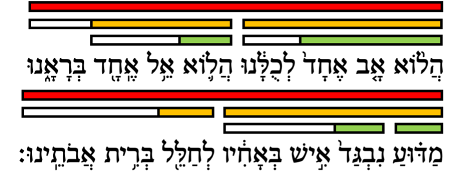
| “Do we not all have one father?” | |
| Did not one God make us?‡ |
| Why therefore, \ are we acting treacherously with each other | |
| so as to defile the covenant of our fathers?‡ |
Verse Summary:
Following the title in verse 1:1, the writer introduces his missive in verses 1:2-5, where he explains that Israel, in particular the Levites, did not really believe YHVH loved them. Then in verses 1:6-2:9 he declares that these priests were guilty of dishonoring YHVH by the manner in which they carried out their duty of offering the sacrifices. They would not think of showing this kind of disrespect to their local leaders, yet they dishonored YHVH, who is the sovereign of the earth, and whose name would one day be honored everywhere.
Now in this verse, Malachi begins a new short section, verses 2:10-13. Again, while it may be applied to all of Israel, the brunt of its impact falls directly upon the Levites. He hammers these priests for their failure in their marriage relationships by taking wives outside the faith in disregard for the covenant regulations. In doing this, he says, they are acting treacherously or faithlessly against each other as well as (from verse 11) YHVH himself.
Verse Structure:
The relationship of the athnach segment or first line to the silluq segment or second line is very similar to verse 1:6 in that the athnach sets forth a truth which forms a foundation for an accusation stated emphatically in the form of a question in the silluq segment. However, in this verse, the full athnach segment is formed by a pair of interrogative clauses rather than declarative statements. The first is a noun clause introduced by הלוא in the fractional zaqeph segment. The second, also introduced by הלוא, is a verbal clause in the fractional tiphchah segment.
The silluq segment contains a zaqeph segment and a tiphchah segment. The zaqeph segment is full and is an independent interrogative verbal clause introduced by מדוע. The tiphchah segment is empty and is a dependent result clause.
Word Analysis
הֲל֨וֹא — negative adverb, לֹא לוֹא, no, not + ה interrogative; conjunctive accent, azla; This negates a verbless interrogative clause and expects an affirmative answer. The azla connects the negative adverb with the subject of this clause.
אָ֤ב — noun, msa, אָב, father; conjunctive accent, mahpak or disjunctive accent, virtual geresh; This is the subject of the verbless clause. The mahpak probably is itself rather than a virtual geresh and connects the noun with the qualifying adjective. Father refers to Abraham, the patriarch of the Jewish nation.
אֶחָד֙ — adjective numeral, msa, אֶחָד, one; disjunctive accent, pashta; This adjective qualifies the noun אב, father. The pashta disjunctive separates the subject from the prepositional phrase that follows.
לְכֻלָּ֔נוּ — adjective, msc, כֹּל, all, every +1cp suffix + preposition לְ, to, for; disjunctive accent, zaqeph; The adjective is used substantivally as the object of the preposition ל, which is used to indicate possession. The zaqeph marks the end of the remote segment of line one which is an independent interrogatory clause.
הֲל֛וֹא — negative adverb, לֹא לוֹא, no, not + ה interrogative; disjunctive accent, tebir; This again expects an affirmative answer introducing the second interrogatory clause. The tebir separates the initial interrogatory word apart from the rest of the clause.
אֵ֥ל — noun, msa, אֵל, God, god; conjunctive accent, mereka, אל is the subject of the verb בראנו. This is the second of the three times this word is used by Malachi. The first was in verse 1:9 and the last is in the next verse 2:10. Here as in verse 1:9 the word references the one and only true God probably emphasizing his power and strength as the creator God. In the following verse, however, the word is used in reference to a foreign false god.
אֶֽחָ֖ד — adjective numeral, msa, אֶחָד, one; disjunctive accent, tiphchah; This adjective qualifies previous word אל. The tiphchah falling here separates the subject, אל אחד, ‘one God’, from the verb which ends this athnach segment.
בְּרָאָ֑נוּ — qal perfective 3ms, בָּרָא, to create, fashion, form + 1cp suffix; disjunctive accent, athnach; The perfective use is a definite past. While this would remind the readers of Genesis 1:1, the first common plural suffix has reference a limited group of people in particular rather than all the peoples of the Israel or even the world world, Jewish and non-Jewish. This verse is very similar to verse 1:6 in that the first line sets the stage by stating a truth in the form of two questions which expect affirmative answers. The athnach ends the first line. The second line, silluq segment, then states the issue. This is again done by way of a question.
מַדּ֗וּעַ — adverb, מַדּוּעַ, wherefore, on what account; disjunctive accent, rebia; This interrogative adverb relates the idea in the two clauses of the athnach segment to the question posed in this segment. BDB suggests that this adverb comes from the contraction of מה־ידוע or what being known. (BDB, p. 396). The idea is: “If what was just asked/stated is true, why therefore…” The following question then states the issue. The rebia disjunctive sets this apart from the rest of this zaqeph segment.
נִבְגַּד֙ — qal imperfective 1cp, בָּגַד, to act or deal treacherously; disjunctive accent, pashta; This is a progressive imperfective. “Here the non-perfective, instead of implying that a specific situation has ceased, represents it as ongoing.” (IBHS, p. 504) BDB suggests this word means to “act or deal treacherously, faithlessly, deceitfully , in the marriage relation, in matters of property or right, in covenants, in word and in general conduct.” (BDB, p. 93) That this has reference to marriage relationships can be seen in the next verse and in the next section, verses 2;13-16. This particular verb is used five times in Malachi, (2:10, 11, 14, 15, 16), all these two sections. What must be asked is how were those addressed acting treacherously? While certainly they were dealing faithlessly against YHVH, the next two words, אישׁ באחיו indicate they there acting treacherously or dealing faithlessly against each other as well and thus defiling the covenant of their fathers.
The use of the first common plural form of the verb as well as the first common plural pronouns in the athnach segment show that the writer is identifying with those he addresses. Is he identifying with them simply as a member of the Jewish nation, or since this seems to be directed mainly to the priests, as a member of the priesthood, a Levite? The latter fits the context best, and, if this is so, how then are these priests acting treacherously or faithlessly against each other in a marriage context?
אִ֣ישׁ — noun, msa, אִישׁ, man; conjunctive accent, munach; This is used in a distributive sense with the following word אח to convey the idea of each, every other.
בְּאָחִ֔יו — noun, msc, אָח, brother + 3ms suffix + preposition, בְּ, in; disjunctive accent, zaqeph; The verb בָּגַד may be used without an expressed object or the object may be indicated by the preposition בְ. (BDB, p. 93) Although gender specific pronouns are used with the בְ, this phrase, אישׁ באחיו, is used idiomatically in a genderless distributive sense simply meaning each other. The writer is not asking why they were acting faithlessly against other males, but why they were acting faithlessly against others in their community. See verses 2:14 and 15 where this verb is used with feminine objects.
לְחַלֵּ֖ל — piel infinitive construct, חָלַל, to defile , pollute + לְ, to, for; disjunctive accent, tiphchah; The infinitive construct with a ל is used to “express a consequence of the main verb” (IBHS, p. 607), i.e., a result clause. This is the same word that the writer used in verse 1:12 to describe what the priests were doing to the sacrificial offerings and earlier in verse 1:7 where they were bringing defiled sacrifices to the altar thus defiling YHVH himself. The word refers to anything that breaches moral or ceremonial law. (IBHS, p. 144) The tiphchah marks the concluding near segment of this line and separates the verb from the accentual unit ברית אבתינו, ‘the covenant of our fathers’ which is its direct object.
בְּרִ֥ית — noun, fsc, בְּרִית, covenant; conjunctive accent, mereka; The mereka conjunctive links this construct with the following absolute forming a single accentual unit.
אֲבֹתֵֽינוּ׃ — noun, mpc, אָב, father +1cp suffix; disjunctive accent, silluq; This genitive qualifies the previous word specifying which covenant; it is the covenant of their fathers. This seems to be a genitive of mediated object. “The relationship of the genitive and implicit verb may be of the sort usually mediated by a preposition;” (IBHS, p. 144) This is ‘the covenant [made by YHVH] with their fathers’ This has reference to the Mosaic Covenant and in particular to that part of it which relates to the descendants of Levi, the Levites. See context, verse 2:4. In the next verse, the prophet will explain how these priests have defiled the provisions of this covenant.
Personal Thoughts and Applications:
Our relationships with others, our wives in this context, affects our relationship with our God. If we are acting in any manner not in love towards our wives, or any others in the church, then we have damaged, ruined our fellowship with God. Sin against a brother is sin against God.
✦✦✦ Home ✦✦✦ Malachi Main Menu ✦✦✦ Discourse 2 Menu ✦✦✦
Verse 2:11

| Judah has acted treacherously. | |
| for an abomination has been committed in Israel, that is, in Jerusalem.‡ |
| Indeed! Judah has defiled \ the holiness of YHVH which he loves | |
| and has married the daughter of a foreign god.‡ |
Verse Summary:
In the previous verse Malachi introduced the issue with some rhetorical questions then asks why they acted treacherously with each other with the result they defiled the covenant of their fathers. In this verse he expands upon that by stating that Judah has acted treacherously because an abomination, an act that was morally, physically or ritually repulsive had been committed in Israel, specifically in Jerusalem. They had defiled the holiness of YHVH, a metonymy referring to the priesthood, by taking foreign wives from the peoples around them.
Verse Structure:
The verse divides as is normal into two lines. The athnach domain is full having two subordinate segments. The initial empty zaqeph segment is a verbal clause stating, ‘Judah has acted treacherously.’ The fractional closing tiphchah segment is also a verbal clause beginning with a disjunctive vav. It is epexegetical giving the reason, ‘for an abomination has been committed in Israel, that is, in Jerusalem.’
The silluq domain is also full with two subordinate segments. Each is a verbal clause connected by a copulative vav. The initial full zaqeph is longer and more complex. It is an independent clause with a dependent relative clause. The subordinate rebia segment contains the verb and the stated subject, introduced by an emphatic כִּי, ‘Indeed! Judah has defiled.’ The subordinate near pashta segment of the zaqeph contains the object of the verb and a qualifying relative clause, ‘the holiness of YHVH which he loves.’ The tiphchah segment is another independent clause which explains the zaqeph, ‘and has married the daughter of a foreign god.’
Word Analysis
בָּגְדָ֣ה — qal perfective 3fs, בָּגַד, to act or deal treacherously; conjunctive accent, munach; This is a persistent present perfective. They had done this and the practice was continuing. The munach links the verb with the subject which follows.
יְהוּדָ֔ה — proper noun, msa, יְהוּדָה, Judah; disjunctive accent, zaqeph; subject of the verb בגעה. A couple of questions should arise at this point. If Malachi is speaking more specifically of the priests, why switch from Levi to Judah since priests were not from this tribe? Is he now still speaking about the priests, or has he changed his focus and begun speaking to the nation in general? This student understands he is continuing addressing the Levitical priesthood in particular. The context supports the latter. The name Judah, as a metonymy, became used as a general term for the inhabitants of the area with the focus on the location. This is supported by the use of the prepositional phrases בישׂראל ובירושׁלם in the tiphchah segment of the first line. These priests, by their actions in their personal lives and then by their offering the sacrifices in the temple in Judah and Jerusalem had acted treacherously and committed an abomination. The second question is why did the writer use the third feminine singular form of the verb with a normally masculine noun as the subject? The answer probably is a missing head noun, ארץ, “in the land (feminine) of Judah (masculine).” (IBHS, p. 104) The gender of the verb is being determined by ארץ rather than יהודה. This also indicates the writer is referencing the area rather than the tribe. The zaqeph marks the end of the first half of line one.
וְתוֹעֵבָ֛ה — noun, fsa, תוֹעֵבָה, abomination + disjunctive vav; disjunctive accent, tebir; The vav is disjunctive being attached to the noun rather than the verb. Since the setting is the same, the connection seems to be explanatory stating why Judah has acted treacherously. It was treacherous or faithless because the priests had committed an abomination in Israel and in Jerusalem specifically. This word denotes something that is repulsive in a physical, moral or ritual sense. (TWOT, p. 977) This is the subject of the clause. The tebir disjunctive separates the subject from the verb which follows.
נֶעֶשְׂתָ֥ה — niphal perfective 3fs, עָשָׂה, to be done, committed, made; conjunctive accent, mereka; Again this is a persistent present perfective. The mereka joins the word with the next word.
בְיִשְׂרָאֵ֖ל — proper noun, msa, יִשְׂרָאֵל, Israel + preposition, בְּ, in; disjunctive accent, tiphchah (יִשְׂרָאֵל) — Israel; The preposition ב is spatial, denoting where this abomination was being committed. The tiphchah, which marks the near subordinate segment of the first line, necessarily falls on this word, which is the word before the athnach. While it would seem more logical to me to switch the accenting on this word and the previous, thus joining the two prepositional phases and disjoining them from the subject/verb, this probably was not done due to the number of combined syllables in the last two words. Or there might have been other musical reasons?
וּבִירֽוּשָׁלִָ֑ם — proper noun, fda, יְרוּשָׁלַ֫םִ יְרוּשׁשלַ֫יִם, Jerusalem + preposition, בְּ, in +vav; disjunctive accent, athnach (יְרוּשָׁלַ֫םִ יְרוּשׁשלַ֫יִם) — Jerusalem; This phrasal vav joining a territory and a city, I understand to be more specifically explaining the first noun, i.e., an explicative vav. (IBHS, p. 649) The athnach ends the first line.
כִּ֣י׀ — conjunction/emphatic particle, כִּי, that, for if, when, indeed; disjunctive accent, legarmeh ; While almost every English version of this verse takes the כי as a causal particle here it seems best to this student to understand it as an emphatic adverb. The silluq segment not the logical cause for the athnach, rather it expands upon it.
חִלֵּ֣ל — piel perfective 3ms, חָלַל, to defile , pollute; conjunctive accent, munach; This is the third time the writer has used this verb. In verse 1:12, Malachi accused the priests of defiling YHVH’s name by their offering of defective sacrifices upon the altar. In the previous verse he accused them of defiling the covenant of their fathers, i.e., the provisions made to the Levites in the Law. Here he accuses them of defiling ‘the holiness of YHVH.” Again, this is a persistent present perfective indicating something continuing into the present. The munach conjunctive connects this verb with its subject which follows.
יְהוּדָ֗ה — proper noun, msa, יְהוּדָה, Judah; disjunctive accent, rebia; subject of the verb חלל; While this term is wide and includes the whole nation, the priests in Judah seem to be the main focus. The rebia marks the remote segment of the zaqeph segment, which is the first half of the second line. It separates the verb/subject from the object of the verb.
קֹ֤דֶשׁ — noun, msc, קֹ֫דֶשׁ, apartness, holiness; conjunctive accent, mahpak or disjunctive accent, virtual geresh; According to TWOT, “The noun qōdesh connotes the concept of “holiness,” i.e. the essential nature of that which belongs to the sphere of the sacred and which is thus distinct from the common or profane.” The authors of this reference also state that it refers, “…also to his character as totally good and entirely without evil.” (TWOT, p. 787) The mahpak does not represent a transformed geresh but is a conjunctive and unites this word, a construct, with the following absolute.
יְהוָה֙ — proper noun, msa, יְהוָה, LORD YHVH; disjunctive accent, pashta (יְהוָה) — LORD, YHVH; This is the absolute of the preceding construct. What function does this genitive have here? Since קֹדֶשׁ, holiness, seems to refer to state of set apartness it seems to be a genitive of quality. The genitive has or possesses the quality of the construct. The state or quality of holiness possessed by YHVH; (IBHS, p. 183) This holiness, being the nature or quality of YHVH himself, is then used as a metonymy of adjunct to refer to those people, places or things that reflect YHVH’s presence or character. This could refer then to the altar, the temple or sanctuary, those who serve there, or even the city of Jerusalem being the location of the temple. Of these the context seems to favor the people or priests who served there, since these are described by the following relative phrase as those which he loved See verse 1:2. In the second line, the writer explains how this holiness has been defiled by stating that he has married the daughter of a foreign god See Nehemiah, chapters 11 and 12. The pashta separates this word unit from the following relative phrase qualifying it.
אֲשֶׁ֣ר — relative pronoun, אֲשֶׁר, who, which, what, whom; accent, munach; The antecedent of the relative pronoun is כדשׁ יהוה, ‘the holiness of YHVH’. It serves as the direct object of אהב, ‘he loves,’ The munach ties this word to the following verb.
אָהֵ֔ב — qal perfective 3ms, אָהֵב, to love; disjunctive accent, zaqeph; This is a durative stative perfective indicating an on going state.
וּבָעַ֖ל — qal perfective 3ms, בָעַל, to marry, rule over +vav copulative; disjunctive accent, tiphchah; This continues the persistent present perfective idea found in הִלֵּל. The tiphchah marking the closing near segment also separates the verb/subject from its object.
בַּת־ — noun, fsc, בַּת, daughter; maqqeph; The phrase, ובעלבת־אל נכר, a daughter of a god of foreignness is idiomatic for a woman of a different faith, a foreign woman. It should be noted that this was forbidden to a Levite. It also implies that the wife was still a worshipper of the false god.
אֵ֥ל — noun, msc, אֵל, God, god; conjunctive accent, mereka; Used figuratively, denoting not the literal offspring of a god, but a woman who worshipped a foreign or false god.
נֵכָֽר׃ — noun, msa, נֵכָר, foreignness; disjunctive accent, silluq; This is a descriptive genitive. A god of foreignness means a foreign god.
Personal Thoughts and Applications:
In the deepest and most complete sense the holiness of YHVH indicates his apartness as uncreated creator from all that which he has or will create. In such a sense he is totally ‘other’ compared to all else that is. It includes the absolute completion of perfection of his attributes and character. He is existence, goodness, love, justice, wisdom, knowledge, creativity, power, and such. He defines these; they exist in him in perfection. Some of these at least have been communicated to his creation, at least in part. Because that is what he is, all that he made was good and right and wise at least in the beginning, even Satan himself. But sin entered, through the choice of the creature and infected all the creation. That which was made in perfection became less. Goodness diminished became evil; life diminished became death; love diminished became hate and so on.
The priests, Levites were the holiness of YHVH. They were to represent that, and, as such, they were held to higher standards than the average Israelite. In intermarrying with the surrounding peoples, they had slipped and had defiled the priesthood, the holiness of YHVH.
✦✦✦ Home ✦✦✦ Malachi Main Menu ✦✦✦ Discourse 2 Menu ✦✦✦
Verse 2:12

| May YHVH cut off the one who is doing this who is fully aware, | |
| from the tents of Jacob‡ |
| and who brings an offering | |
| to YHVH of Hosts!‡ |
Verse Summary:
Malachi, after pointing out the error of these priests in taking foreign unbelieving wives, emphasizes the seriousness of their actions by an exclamation, an imprecation against those he has described. He implores YHVH to cut off, to remove from Israel, those who do this, i.e., those who take unbelieving wives from outside Israel, being fully aware of their actions and then who continue to minister in the priesthood by offering the sacrifices.
Verse Structure:
The verse, as is normal, has two major segments. The full athnach domain contains the main verbal statement in the zaqeph segment, ‘May YHVH cut off the one who is doing this who is fully aware….’ The tiphchah segment is a prepositional phrase qualifying the extent or degree of this action. The silluq domain, the second half of the verse is a relative participial phrase qualifying those YHVH is to cut off, giving a concomitant circumstance to their being married to foreign wives. They are continuing to minister by bringing sacrifices to YHVH, ‘and who brings an offering to YHVH of Hosts.’
Word Analysis
יַכְרֵ֨ת — Hiphil jussive 3ms, כָּרַת, to cut off, destroy the life of; conjunctive accent, azla; With Hiphil active transitive verbs the ל is often used to introduce the direct object. (IHBS, p. 210 and footnote #85) BDB suggests - “May Yahweh cut off to the man – from the tents of Jacob.” (BDB, p. 504 under Hiphil 2.b) While this might be simple a specific future stating YHVH will judge those who does this, the context strongly suggests this is an emotional response on the part of the prophet and the verb form should be taken as a jussive (IBHS, p. 566). The azla conjoins the verb with the stated subject which follows.
יְהוָ֜ה — proper noun, msa, יְהוָה, LORD YHVH; disjunctive accent, geresh; This is the subject of the verb, יכרת. Since this is a volitive directed toward a superior, it is a request rather than a direct command. In this case it would be a malediction, the opposite of a benediction. (IBHS, p. 568) The geresh disjunctive sets the verb and subject apart from the rest of the clause.
לָאִ֨ישׁ — noun, msa, אִישׁ, man + לְ, to, for; conjunctive accent, azla (אִישׁ) — In this case the ל might denote in reference to the man—distributive use perhaps. It does introduce the object of this verb in the Hiphil. The azla conjunctive on this word and the mahpak on the following unite the relative pronoun and the word it introduces to its referent.
אֲשֶׁ֤ר — relative pronoun, אֲשֶׁ֤ר, which, what; conjunctive accent, mahpak; Note that this accent must be a mahpak and not a virtual geresh since a geresh is found on יהוה and is not repeated (PRCE, p. 93). The relative introduces a verbal clause qualifying the אישׁ the object of the verb יכרת.
יַעֲשֶׂ֨נָּה֙ — qal imperfective 3ms, עָשָׂה, to do, make +3fs suffix; disjunctive accent, pashta; This is either a progressive imperfective indicating the action is an ongoing at the time the prophet was speaking, ‘who is doing this,’ or an habitual imperfective indicating a repeated nonspecific action, ‘who does this.’ The overall sense is much the same. The pashta marks the near subordinate domain of the zaqeph segment.
עֵ֣ר — qal participle msa, עוּר, to rouse oneself, awake; conjunctive accent, munach; This relative participle and the following one connected by a conjunctive vav form a hendiadys. (IBHS, p. 653) They, taken together, describe the state of the subject of the verb יעשׂנה. They are awake and responding, i.e., they are fully awake or fully aware. They understand what is happening; they are doing what they are doing, being married to foreign wives who do not worship YHVH with eyes wide open. The munach unites this word with the next into a single accentual unit.
וְעֹנֶ֔ה — qal participle msa, עָנַה, to answer, respond + vav; disjunctive accent, zaqeph; With the previous participle, this describes the state of the subject of the main verb יעשׂנה. They are awake to the degree they are responding, fully roused, alert and aware. The zaqeph marks the end to the first part of line one.
מֵאָהֳלֵ֖י — noun, mpc, אֹ֫הֶל, tent + מִן, from, because of, on account of / some of; disjunctive accent, tiphchah; The tiphchah segment is a prepositional phrase qualifying the main verb יכרת. They are cut off from the tens of Jacob, i.e., from the nation of Israel.
יַֽעֲקֹ֑ב — proper noun, msa, יַּעֲקֹב, יַעֲקוֹב, Jacob; disjunctive accent, athnach; absolute following the prior construct. The athnach concludes line one which is the beginning of an imprecation delivered by the prophet against those who were taking foreign wives. The following silluq segment completes the description of those he wishes YHVH to cut off.
וּמַגִּ֣ישׁ — Hiphil participle msa, נָגַשׁ, to bring near, bring + vav; conjunctive accent, munach; This is another relative participle describing the object of the verb יכרת, the man who is married to a wife who does not worship YHVH being fully aware of the situation and yet who brings an offering to YHVH of Hosts. It was possible for an Israeli man to marry a foreigner wife, but the wife then became a worshiper of YHVH. These priests, however, were held to a higher standard. They were to marry within their own tribe, not outside foreigners, and there were other restrictions as well to ensure the ceremonial purity and holiness of the priesthood. But these priests were taking wives who were not converts to the worship of YHVH and continued to minister as priests making offerings to YHVH. The vav is conjunctive sequential. They are fully aware of the issue of taking an unbelieving wife and then they continue to minister as priests before YHVH! The munach unites the participle with its object.
מִנְחָ֔ה — noun, fsa, מִנְחָה, gift, tribute, offering; disjunctive accent, zaqeph; This is the direct object of participle ומגּישׁ. The zaqeph marks the end of the first part of the second line.
לַֽיהוָ֖ה — proper noun, msc, יְהוָה, LORD YHVH + לְ, to, for; disjunctive accent, tiphchah; The ל indicates the indirect object of the verb ומגישׁ. The tiphchah marks the near subordinate domain of the silluq segment, the last part of the second line.
צְבָאֽוֹת׃ פ — noun, mpa, צָבָה, host, army, war, warfare; disjunctive accent, silluq; This is the absolute following the construct יהוה. The silluq ends the second line.
Personal Thoughts and Applications:
Those who ministered before YHVH were required to maintain the highest standard of holiness. Those that did not and who knowingly violated the regulations set by YHVH and yet continued to serve as priests were acting treacherously, betraying their own people. They were defiling the priesthood and bringing judgment on themselves and the people they served. So serious is this, Malachi calls on YHVH to cut them off, remove them from the nation.
How polluted has the Christian ministry today become? Yet how concerned are we as believers about this? What about my/our own life/lives? Do I/we continue to test his grace by living in a manner inconsistent with his standards and continuing to present an appearance of being his minister?