Barton's Bible Study Notes

Notes on Psalm 2
With Attention to the Masoretic Accents

Table of Contents

Foreword Major Sources Introduction
Verse 1 Verse 2 Verse 3
Verse 4 Verse 5 Verse 6
Verse 7 Verse 8 Verse 9
Verse 10 Verse 11 Verse 12

Exit (Go to Home)


Foreword

The following is a collection of my personal notes from my study on the Hebrew text of Psalm 2. It is not intended as a scholarly work for publication. Therefore, expect spelling errors, typos and other such things. You will find them! There are probably some html coding errors as well; I’m still trying to learn that. It includes identification (parsing) of the Hebrew words, grammar and syntax notes and references to tools for studying the text, ideas I needed to remember next time I studied the text, and just about anything I thought I might want to be able to go back and review or restudy. Also some notes for anyone else trying to make sense of my notes.

The translation given is my own for the most part. It is not intended to be a good smooth politically correct English, but one to help me, at least, understand the intent and structure of text. If I were teaching this passage, I certainly would not use this transation for public reading. For more readable English translations use the NASV or NIV or another that suits you.

If these notes is helpful to you, great! use them. If not, you are not required to read any further. Comments and corrections are always appreciated yet not required. I try to listen with an open mind; however, I’m not really interested in pointless theological or philosophical debates. In any case, may my Lord and God richly bless you!

Go To Table of Contents


List of Major Sources

BDB Hebrew and English Lexicon of the Old Testament, Francis Brown, S. R. Driver and Charles A. Briggs (Houghton Mifflin Company, Boston and New York, 1907)
BHS Biblia Hebraica Stuttgartensia, 5th ed, (Deutsche Bibelgesellschaft, Stuttgart 1967/77)
BUL Figures of Speech Used in the Old Testament, E. W. Bullinger (Baker Book House, Grand Rapids, Michigan, 1968)
GKC Gesenius' Hebrew Grammar, 2nd English Edition, ed. by E. Kautzsch, trans. by A. E. Cowley (Oxford University Press, London England, 1956)
IBHS An Introduction to Biblical Hebrew Syntax by Bruce K. Waltke and M, O’Connor, (Eisenbrauns, Winona Lake, Indiana, 1990)
PRICE The Syntax of Masoretic Accents in the Hebrew Bible, 2nd, ed., revised and corrected, James D. Price, Ph.D. (Temple Baptist Seminary, Chattanooga, Tennessee, 2010)
ROSS Allen P. Ross, The Bible Knowledge Commentary, Old Testament ed., ed. John F. Walvoord and Roy B. Zuck (Wheaton, IL: Victor Books, 1985)
TWOT Theological Wordbook of the Old Testament, ed. by R. Laird Harris,et al 1st ed. (Chicago, IL: Moody Bible Institute, 1980)

Go To Table of Contents


Introduction

Introduction to the Book of Psalms

The Book of Psalms is the hymnal, the songbook of ancient Israel. The word psalm originally meant the music of a stringed instrument, but has come to mean a song, which was sung often accompanied by the music of such an instrument. These songs were sung or chanted by believers as they worshipped God.

The Book of Psalms is also poetry, for songs are poems set to music. The psalms are Hebrew poetry. They were originally composed and written in Hebrew, and thus, they follow the ancient Hebrew rules for poetry not our modern ones.

In our poetry we usually have rhythm and rhyme although there are poems that have one without the other and some which have neither. In ancient Hebrew poetry rhythm was not a very important factor. Even if a psalm were composed having meter, which is debatable, this is lost in the process of translation into English or any other language. Therefore, none of the Psalms in translations will normally have a regular beat or rhythm. Rhyme was not important in Hebrew poetry either. The writers did not rhyme the last words of lines together as we do. Even if they had done this, it too would be lost when translating Hebrew. Therefore, in translation, none of the psalms rhyme.

The Book of Psalms was not written at a single point in Israel’s history. It was written over a period of roughly a thousand years. There were many different men whom God used to pen these poems or songs. There is a psalm by Moses (Psalm 90), seventy-three psalms stated to be by David, twelve by Asaph (Psalms 50, 73-83), a psalm by Heman, the Ezrahite (Psalm 88), one by Ethan, the Ezrahite (Psalm 89), and two psalms by Solomon (Psalms 72, 127). Other psalms do not have an author indicated. Many of these were also written by David, others by unknown authors through the inspiration of the Spirit of God.

There were probably four stages in the development or formation of the Book of Psalms as we know it today: (1) composition of the individual poems, (2) the collection of these individual poems into collections or anthologies, (3) the putting together of these smaller anthologies into the Five Books of Psalms, and (4) the work of a final editor to order and arrange the whole. Although we do not know who the individual collectors and editors might have been, we are convinced and believe they were guided and led by the Spirit of God much as were the original authors who composed these psalms so that what we have today is the inspired work of God.

The Book of Psalms is actually The Five Books of Psalms, for the psalms are divided into five books. These are:

Book 1:  -  Psalms 1-41
Book 2:  -  Psalms 42-72
Book 3:  -  Psalms 73-89
Book 4:  -  Psalms 90-106
Book 5:  -  Psalms 107-150

Each of these books ends with a doxology, a short statement of praise; 41:13 (Book 1), 72:18-20 (Book 2), 89:52 (Book 3), and 106:48 (Book 4). Psalm 150 is itself the doxology of the last book and of all Five Books taken together. Psalm 1 not only introduces the First Book, it also forms the introduction to all Five Books as well. There have been many suggestions as to why the psalms are divided into five books. Some have suggested they parallel the Law, the first five books of the Old Testament but there seems to be very little evidence for this.

Go To Table of Contents


Concerning the Masoretic Accents

Although many authorities and expositors disregard the Hebrew accents thinking they are only important in the cantillation or chanting of the text, evidence indicates otherwise.

“The accent system punctuates the text and is therefore a very important feature in its syntactic analysis; despite the term accent, the system does not primarily refer to the pitch or duration of the words. This feature of Hebrew grammar is so important for understanding that medieval Jewish sources paid more attention to it than to establishing the correct pronunciation of words….At present it is best to consider the accents as an early and relatively reliable witness to a correct interpretation of the text.” (IBHS, pp. 29-30)

Just as poetry in English is divided into lines and often stanzas by punctuation marks and spacing, so too Hebrew poetry was divided by accent marks. However, these were much more extensive and complicated than English punctuation. James Price states:

“The accents in Biblical Hebrew serve four purposes: (1) phonetically they mark the syllable that receives the principal stress in pronunciation; (2) syntactically they indicate the degree of grammatical separation or connection between adjoining words and phrases much like punctuation marks in English; (3) musically they indicate the relative intonation of a word in cantillation; and (4) in addition, they often reflect the poetic structure of the text.” (PRICE, p.9)

Accents serve both syntax and the poetic structure and thus there are times when one weighs more heavily than the other, concerning this Price also states;

“In poetry, grammatical syntax and poetic structure are usually in harmony. So the accents can usually be expected to reflect the syntactic relationships as well as poetic structure. However, whenever grammatical syntax and poetic structure fail to harmonize, the accents usually agree with the poetry rather than the syntax….Interpretation should always agree with the syntax of the Hebrew language whenever the poetic structure is in disharmony.”

This is also true in the poetry of the English

There are two different systems of accents marks found in the Hebrew text of the Old Testament, one system is used in those books regarded as poetry, Psalms, Job and Proverbs. Another is used in the remaining books which are labeled as prose, although it should be noted that much of the prose or narrative is heavily poetic in character.

Go To Table of Contents


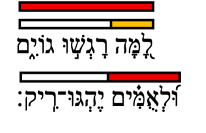
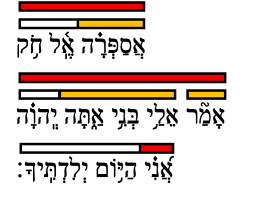
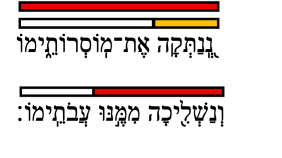
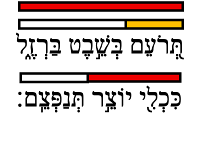
Guide to Colored Bars Above Hebrew Text

Each Hebrew text of a verse has a series of colored bars above them indicating the Masoretic accentual pattern. This pattern is based upon the syntax presented in The Syntax of Masoretic Accents in the Hebrew Bible, 2nd, ed., revised and corrected, James D. Price, Ph.D. (Temple Baptist Seminary, 2010, Chattanooga, Tennessee). Hebrew accents fall into two major divisions; disjunctive accents separate one word or accentual unit from another and conjunctive accents which bind word or accentual units together. For the accents of the poetic books, Job, Proverbs and the Psalms, there are four levels of division or hierarchies of disjunctive accents. Each of these disjunctives marks or names a segment/domain or part of a division of the text. In many cases, they also mark the division point in the text. The first or highest level of division is the segment marked by the silluq accent which falls on the last word of the verse. This segment is not represented by a colored bar but consists of the verse as a whole. Thus, the verse is the silluq segment or domain. The soph pasuq (׃) invariably follows the silluq also marking the end of a verse. The verse or silluq segment then is divided into one, two or three subordinate hierarchy II domains or segments. A near subordinate rebia mugrash domain is always present. Note that while it marks or names this subordinate segment, it does not mark the word which ends the segment since it will always fall on the next to the last accentual unit before the end of the verse. The laws of accentuation limit one accent per word unit not counting secondary auxiliary accents such as metheg or its substitutes. If there is a single subordinate remote division in the verse, it may be either an athnach or ole vejored segment; This accent will mark the end or last word of that division. If there are two remote divisions or domains, the initial one is an ole vejored segment and the second or middle domain is an athnach segment. Again, these will mark the end of their respective segments. Each of these segments may be further divided into one or more hierarchy III subordinate domains, and the hierarchy III segments in turn may be divided into one or more hierarchy IV subordinate domains.

A red bar indicates a hierarchy II segment; a rebia mugrash (or its substitute a great shalsheleth), an athnach or an ole vejored. An orange bar indicates a hierarchy III segment; a dechi (or virtual dechi), sinnor, little rebia or great rebia. A green bar indicates a hierarchy IV segment, a pazer or legarmeh (or virtual legarmeh). A blue segment in the orange bar beneath the red bar indicates the auxiliary use of a subordinate legarmeh segment in the silluq proper domain or athnach and rebia mugrash domains. A blue bar beneath the green bar indicates a subordinate legarmeh near domain of a pazer segment.

For the hierarchal divisions and rules of accentuation see PRICE. If the segment of any hierarchy is a subordinate near domain, the white portion of the bar represents the word on which the superior governing disjunctive rests and any words or word-units joined to it by a maqqeph or a conjunctive accent.

While it is not always possible to carry the Hebrew accentual system over into an English translation, an attempt has been made to indicate some of the disjunctives separating units of thought. The Hebrew accents serve not only to mark the cantillation or chanting of the Hebrew text, they also serve as punctuation symbols. Because there are many more Hebrew accents than English punctuation marks and because they follow a much different set of rules, it is not possible to state one Hebrew accent is equivalent to one English punctuation mark. However, they are just as important for understanding the text in Hebrew as English punctuation marks are for understanding the text in English. The translation provided in this study is not intended to be smoothest, best sounding modern English. It certainly does not achieve that. For public readings and to read through larger portions to gain an overall view of the meaning or sense of the text, the author suggests using one of the major modern translations available. Instead, it is an attempt to show the Hebrew structure as much as possible.

A full segment is one that has a subordinate near domain (a segment governed by a disjunctive in the hierarchy immediately below it) and one or more subordinate remote domains. A fractional segment is a segment with only a subordinate near domain. An empty segment is a segment with no subordinate domains.

Go To Table of Contents


Introduction to Psalm 2

This Psalm is a royal messianic psalm, that is, it has a reference to the Messiah, Jesus Christ our Lord as king. Many of the psalms are messianic (Psalm 2, 22, 34, 45, 72, 96-97, 110 and others). These psalms may refer to the Messiah in several ways. They refer to the Messiah in that some feature of the subject of the psalm is an example of Christ. What is stated ultimately has its fulfillment in the Messiah. Sometimes what is stated of the subject of the psalm may only have its fulfillment in Christ while other times there is often a near fulfillment (or a near reference) and a far fulfillment (a far reference). Some refer to the kings of the line of David but await the final King of David's line, the Messiah. Some speak of the coming of the LORD to rule and reign and therefore have their fulfillment in the person of Jesus Christ.

This psalm does not have a superscription in which the author is identified. However, we might know who wrote it. The first two verses of this psalm are quoted in Acts 4:24-27.

4:24 And when they heard this, they lifted their voices to God with one accord and said,
“O Lord, it is You who MADE THE HEAVEN AND THE EARTH AND THE SEA, AND ALL THAT IS IN THEM,
4:25 who by the Holy Spirit, through the mouth of our father David Your servant, said,
‘WHY DID THE GENTILES RAGE
AND THE PEOPLES DEVISE FUTILE THINGS?
4:26 ‘THE KINGS OF THE EARTH TOOK THEIR STAND,
AND THE RULERS WERE GATHERED TOGETHER
AGAINST THE LORD AND AGAINST HIS CHRIST.’
4:27 “For truly in this city there were gathered together against Your holy servant Jesus, whom You anointed, both Herod and Pontius Pilate, along with the Gentiles and the peoples of Israel,

The speakers, probably the apostles, seem to indicate that the author is David. Many authorities suggest that when a psalm is attributed to David, the writer or speaker is simply referring to the Book of Psalms whether or not David was the actual author. While this is possible, the language, “through the mouth of our Father David Your servant,” seems to indicate more than this just comes from the psalms. The Psalm itself fits exactly the context of David’s reign. It refers to events that took place in his life, so almost all conservative authorities understand David to be the author. So, when David writes this, he is speaking about the conditions in his day where the surrounding nations are fighting against him (a near fulfillment), but ultimately the future (far) fulfillment will come in last days as Jesus, the Messiah is crowned the King of kings and Lord or lords extending through the millennial reign of our Lord and into the final rebellion after Satan has been released again upon the earth.

The psalm is easily divided into four sections or stanzas of three verses apiece.

1. The Plot of the Nations (verses 1–3)
2. The Response of YHVH (verses 4–6)
3. The Testimony of the Anointed (verses 7–9)
4. The Plea of the Psalmist (verses 10–12)

In verses 1–3, the psalmist, David (Acts 4:25), asks a question. It is rhetorical, not so much expecting or wanting an answer but to express indignation. Why are the nations plotting to try to rebel against YHVH/The LORD and the anointed one, that is, the king? They are trying to get out from under the YHVH’s authority and his Anointed One’s rule. YHVH answers them in verses 4–6. Using an anthropomorphic figure, the psalmist states that the YHVH laughs in scorn at their attempt. He says that he will speak (in judgment). He affirms that it was he, YHVH, who appointed his king in Jerusalem. In the following verses, 7–9, it is the king, the Anointed One, who speaks. He testifies to the decree of YHVH that gave him the right to rule the world. This is the divine right of kings rightly applied. God, in the Davidic Covenant, had appointed him as king. Having stated these things, the psalmist, David, concludes and pleads with the world’s leaders to recognize and submit to the YHVH’s rule through the king he appointed. Furthermore, in the last part, verses 10–12, David warns these world leaders, “Be advised; you either submit, or you will perish.”

The most common structure of a verse in this psalm is to have two lines, each having two or three accentual units somewhat parallel in thought, verses 2:1, 3, 4, 5, 9, 10 and 11. In these verses, the subordinate remote athnach segment makes up the first line and the subordinate near rebia mugrash, the second. The athnach and rebia mugrash accents also mark the major syntactical divisions, each line being an independent clause. Verses 2:6 and 2:8 also have two lines marked by athnach and rebia mugrash, but they are not separate independent clauses. The remaining three verses have three lines, again each with two or three accentual units. In two of these, 2:2 and 2:12, the full athnach segment supplies two lines with the division marked by the great rebia disjunctive; the empty rebia mugrash is the third line. In verse 2:7, the ole vejored disjunctive marks the end of the first line, the athnach marks the end of line two and the rebia mugrash segment marks the third line. The stanza, line and accentual units structure of this psalm is:

Stanza 1 Stanza 2 Stanza 3 Stanza 4
Verse 1 - 2/2 Verse 4 - 2/2 Verse 7 - 2/3/2 Verse 10 - 2/2
Verse 2 - 2/2/2 Verse 5 - 3/2 Verse 8 - 3/2 Verse 11 - 2/2
Verse 3 - 2/2 Verse 6 - 2/2 Verse 9 - 2/2 Verse 12 - 3/2/2

Go To Table of Contents


Verse 1

Psalm 2:1

Why | do the nations conspire;

and the peoples | mutter emptiness?

The verse, or the silluq segment, is divided into two poetic parallel lines. By parallel, it does not mean the writer states exactly the same idea in different terms. Much of the time what is said in both lines is indeed very similar with each line portraying different aspects of a central idea. Sometimes the lines might even be opposite (verse 2:12), but in showing two sides of the proverbial coin; the lines complement each other, and by a contrast, convey one major idea. One line might state the basic idea, the second add to it another element reinforcing, emphasizing or expanding the idea. But almost always there will be one central idea the writer is communicating.

The first line is the fractional remote athnach segment having only a near subordinate dechi segment consists of one word, the interrogative pronoun with the prefixed preposition לְ. The remainder of the athnach segment is the word-unit on which the athnach accent falls. This is designated as the athnach proper portion of the segment and represented by the white portion of the bar. It consists of two words, a single accentual unit, forming an independent clause.

The second line, or near rebia mugrash segment consists of two accentual units and is an empty segment having no subordinate domains. The rebia mugrash disjunctive falls on the first of these and the second is the proper domain of the silluq disjunctive ending the verse again represented by the white portion of the bar above the text.

לָ֭מָּה preposition לְ + interrogative pronoun, מָה; for what reason, why; The dechi disjunctive marks the near subordinate domain of the athnach segment. Note: it does not mark the end of the subordinate near domain (this extends to the last word in the athnach segment). but since a word unit may only have one accent (not counting secondary auxiliary accents such as metheg or its substitutes) on the stressed syllable, it necessarily falls here. It cannot be placed upon the word having the athnach nor on the word before it which has a conjunctive accent. Although the interrogative pronoun is connected with the first independent clause in the athnach segment marking it as a question, it is understood to apply to the second independent clause in the rebia mugrash segment as well. While both lines are to be understood as questions, these are rhetorical questions in that they are not seeking answers but rather expressing the author’s amazement that the people and nations of the world would do such a thing.
רָגְשׁ֣וּ qal perfective, 3cp, רָגַשׁ; to conspire, to plot (TWOT, p. 833) (hypox); The munach conjunctive closely ties this word, a verb, with the word that follows which is its stated subject; This probably a gnomic perfective (IBHS, p.487) representing something that the nations under the Messiah’s authority do. They may or may not be doing at the time of speaking, but they have done it, and they will do it again. David experienced opposition throughout his reign. Our Lord will experience opposition to his reign from his coronation to the final rebellion following Satan’s release from captivity.
גוֹיִ֑ם noun, mpa, גֹּוי; nation; The athnach disjunctive marks the end of the subordinate remote domain of the silluq segment or verse and the end of the first poetic line. Note: disjunctive accents marking subordinate remote domains fall on the last word of the domain and so mark their end. This is not the case with disjunctives marking subordinate near domains which cannot do this. While the this word can and often does refer to the Hebrew nation and people, it most often refers to the non-Jewish nations of the world which is its meaning in this context. (BDB, p. 156)
וּ֝לְאֻמִּ֗ים vav+ noun, mpa, לְאוֹם לְאֹם; people; The rebia mugrash disjunctive marks the subordinate near domain of the silluq segment or verse and the second line. The vav is an epexegetical vav introducing a second independent clause parallel to and expanding upon the clause in line one (IHBS, p. 652). Again, it should be noted that because this is a near subordinate domain the accent does not mark its end; it extends through the word bearing the silluq accent. In the first line above, the verb and subject pattern was V-S; in this line it is S-V. This chiastic arrangement is a common element in Hebrew poetry. See also verses 2:2, 5, 8, 9 and 10 where this pattern is also found.
יֶהְגּוּ־ qal imperfective, 3mp, הָגָה; to moan, growl, utter, speak, muse; The maqqeph joining this word with the next forms a single accentual word-unit. A maqqeph is not an accent mark but is used to connect a shorter word with the following word to form one word-unit. This is an habitual imperfective used in association with the gnomic perfective in the first line focusing the habitual activity of the people (IHBS, p. 506).
רִֽיק׃ noun, msa, רִיק; emptiness, vanity; The silluq disjunctive along with the associated soph pasuq marks the end of the verse and the second poetic line. The noun may be an accusative indicating the direct object of the verb יֶהְגּוּ; in which case the idea is they were uttering, growling, muttering emptiness, that is, empty or useless threats or statements. If the noun represents an adverbial accusative, then the idea is slightly different, they were uttering, growling, muttering, etc. in vain, uselessly with the idea that what they were doing would not change anything. The overall significance is much the same.

This psalm while having a near fulfilment in David’s day is also prophetic of the end times, from the second coming of our Lord to set up his kingdom extending through the rebellion of the world following the release of Satan at the end of the millennial kingdom. That this is so, is seen by the fact that the nations in this psalm are pictured as under Messiah’s authority which has been confirmed and established by YHVH, authority which they want to throw off. At the second coming, the nations are not yet under his authority, nor has he been installed as king in Jerusalem, but he has been crowned in the heavens. The nations, under the leadership of the Antichrist empowered by Satan resist his coming to rule.

While the best interpretation of this psalm is that of being a prophecy of opposition to the future reign of our Messiah, Jesus, there are applications for us today. Just as in David’s day there was opposition to YHVH’s rule so there is today. This psalm warned the nations not to oppose this. In our day, the anointed one does not rule upon earth, not yet at least. But as individuals we can still oppose YHVH’s rule in our live. This application of this psalm warns us not to do so. We must acknowledge and submit to our Lord’s authority in our lives rather than rebelling and doing our own thing our way.

Go To Table of Contents


Verse 2

Psalm 2:2

They take their stand, | (the) kings of the earth;

and leaders | seat themselves in conclave together

against YHVH | and against his Anointed One (Messiah).

Verse 1:2 is divided into two segments, a remote full athnach segment and an empty near rebia mugrash segment. However, there are three poetic lines. The full athnach segment contains two lines, the empty rebia mugrash makes a third. The long athnach segment is divided into two parallel independent clauses separated by a great rebia disjunctive forming two poetic lines. In the Hebrew text, each of these consists of two accentual units. The third line, the rebia mugrash segment also consists of two accentual units. In this verse the athnach disjunctive follows the poetic structure more so than it does the syntactic. Instead of separating the two parallel independent clauses, the athnach falling where it does, treats them as one entity/idea and separating this idea from the adverbial prepositional phrases which then qualify this single idea. That is to say, the idea that the nations are rising up in rebellion has equal weight with the idea of whom they are rebelling against. While wanting freedom is in itself not necessarily a bad thing, wanting to be free from YHVH’s authority and his designated ruler is.

יִ֥תְיַצְּב֨וּ ׀ hithpael perfective, 3cp, יָצַב; to take ones stand; The azla legarmeh disjunctive marks the near subordinate domain of the great rebia segment and falls upon a minor disjunctive separating the predicate from the stated subject. The verb carries the idea of to set or station oneself. It only occurs in the hithpael stem and often has a direct reflexive idea where “the subject is also the direct object of the verbal notion” (IHBS, p. 429). These kings/leaders set themselves up. Here the idea is in opposition to YHVH (TWOT, p. 394). The use of perfective, as in the first line of verse 2:1, is a gnomic perfective which indicates this is something that the king/leaders of the nations do habitually; they oppose YHVH’s rule.
מַלְכֵי־ noun, mpc, מֶ֫לֶךְ; king; The maqqeph joining this word, a construct, with the following, an absolute form forms a single word-unit. While the word itself is king, the reference is to any national leader be it a king, an emperor, a president, a prime minister, a dictator, etc. It is the stated subject of the verb יִ֥תְיַצְּבוּ. This noun lacks the article but may be definite since often in poetry the article is omitted. (IHBS, p.243). Such seems to be the case here where the psalmist is referring to the unique class of top leaders of the nations of the earth.
אֶ֗רֶץ noun, fsa, אֶ֫רֶץ; land, earth; The great rebia disjunctive marks the remote domain of the athnach segment and the end of the first poetic line. Again, the noun is definite although it lacks the article, being one of a kind and English would then use a definite article.
וְרוֹזְנִ֥ים vav + qal participle, msa, רָזַן רָזֹן; to be weighty, judicious, commanding; This word is found only in qal participle. The dechi disjunctive is transformed to a mereka conjunctive (PRICE, p. 202 and p. 204, footnote 20). This virtual dechi marks the empty near domain of the athnach segment. The participle is substantival, the subject of the following verb. It is anarthrous and points to the class of people in authority at whatever level. The first line indicated that the top-most tier of power, i.e., kings opposed YHVH’s rule while this line expands that to indicate those at any level of authority were conspiring together as well. The vav is epexegetical connecting two parallel clauses as in verse 1. The writer uses a chiastic arrangement of predicate and subjects in these two lines.
נֽוֹסְדוּ־ niphal perfective, 3cp, יָסַד; to fix or sit; The maqqeph joins this word a verb with the next, an adverbial accusative forming a single word-unit. As above this is a gnomic perfective. This verb is used four times in the niphal stem in the Old Testament. In two instances the niphal has a passive sense, but in this verse and in Psalm 31:13(14) it has “a reflexive construction…in which the subject and object of the verb refer to the same person or thing.” (IBHS, p. 387)
יָ֑חַד noun, msa, יַ֫חַד; unitedness; The athnach disjunctive, marks the end of the remote domain of the silluq segment and, in this verse, the end of the second line. This word is almost always used as an adverbial accusative meaning in union, together.
עַל־ preposition, עַל; upon, against; The maqqeph unites this preposition with its object forming one word-unit. This use of the preposition is used to express hostility directed against its object, (BDB, p. 1825).
יְ֝הוָה proper noun, msa, יְהוָה; YHVH, LORD; The defective rabia mugrash, appearing as a geresh without the rebia (PRICE, p. 180), marks the near subordinate domain of the silluq and the third poetic line. This is the object of the preposition עַל.
וְעַל־ vav + preposition, עַל; over, upon, according to, against; The maqqeph unites this preposition with its object and forms one word-unit. The vav conjoins the first prepositional phrase with this second with both qualifying the previous parallel clauses. As above, it is used to express hostility.
מְשִׁיחֽוֹ׃ noun/adjective, msa, מָשִׁיחַ; anointed one, messiah; The silluq disjunctive marks the end of the verse along with the associated soph pasuq. It also marks the end of the third line. The word מָשִׁיחַ, māshīaḥ, from which the English word messiah comes, means anointed one. The koine Greek translation of this word is Χρίστος, again meaning anointed one and from which the English word Christ comes. The Hebrew word מָשִׁיחַ is derived from the verb מָשַׁח meaning to anoint or spread liquid on. It is a reference to the custom that a person chosen for some position of authority was anointed with oil as a symbol of YHVH’s choice of that person. The anointed one could be a high priest, a king or even a person chosen to carry out some task even if they were not a believer for God chooses even nonbelievers to carry out his will. Concerning this word, V. P. Hamilton states,
“The Psalm literature especially regards māshīaḥ as God's agent or vice-regent (as in Ps 2:2). In this much discussed passage, the first level of meaning may be that of an immediate Israelite king, as the māshīaḥ against whom, since he is aligned with God, enemies strike in vain. Even the promise that the ends of the earth be the possession of the māshīaḥ fit the anticipations of Israel for their national king (Ps 72:8ff; Ps 18:44--48). But from the NT we learn that the meaning of māshīaḥ in Ps 2 cannot be limited to a king about to be enthroned, but is a reference to the unique vice-regent, Jesus Christ (Acts 13:32ff; cf. Heb 1:5: 5:5). (TWOT, p. 531)”

In verse 2:2, the author of the psalm is narrowing the focus of the scene he described in verse 2:1. In that verse one sees the nations and peoples of the world that are under Messiah’s rule that conspire and mutter. The camera’s focus now draws in upon the leadership of these nations. They agreed together and set themselves up in opposition to the rule of YHVH through his chosen one, the Messiah. The next verse narrows the view still more focusing upon their intentions as expressed in their words or thoughts.

Go To Table of Contents


Verse 3

Psalm 2:3

“Let us tear apart | their restraints!

Let us throw off from ourselves | their bonds!”

Verse 2:3 is divided into two parallel lines expressing a single central idea. A fractional remote athnach segment and an empty near rebia mugrash segment each forms a line. The author, after writing about the nations and their leaders in verses 2:1-2, now changes his method or style and portrays the leaders themselves speaking in this verse. It is an abrupt shift without warning or indication. In the first two verses it is the psalmist speaking, then, suddenly, here the leaders are speaking. This abrupt shift dramatically increases the intensity and focuses the reader/hearer’s attention on the attitude of rebellion. Many English translations weaken this effect by adding the word, ‘saying,’ at the end of the second verse in an effort to make sure the readers realize this change in speakers, but this is not found in the Hebrew text.

נְֽ֭נַתְּקָה piel cohortative, 1p, cohortative ה suffix, נָתַק; to tear apart, away, up or snap; The dechi disjunctive marks the empty subordinate near domain of the athnach segment. The metheg is an auxiliary. The use of the cohortative in this independent clause and the following clause expresses encouragement of the speakers to effect the mentioned course of action (IBHS, p. 573). While the speakers are not named, the context of the previous verse clearly indicates that they are the rulers and leaders of the nations of the world. who are meeting and plotting together.
אֶת־ particle; אֵת; The maqqeph ties this particle with the next word forming a single word-unit. The particle indicates the definite direct object of the preceding verb.
מֽוֹסְרוֹתֵ֑ימוֹ noun, mpc + 3mp suffix, מוֹסֵר; band, bond; The athnach disjunctive marks the end of the first major segment of the verse and the end of the first line. According to Feinberg, “ln its literal sense a band is anything that connects, encloses, confines, or strengthens. Figurative usage denotes that which chastens or restrains.” (TWOT, p. 62) The statement to snap or tear apart their bonds is used in a figurative sense here referencing the restraints placed upon the nations by the Messiah ruling in Zion. This is the object of the particle, the direct object of the verb נְֽנַתְּקָה. The third masculine plural suffix is a subjective genitive indicating the agent of the verbal idea of binding and has as its antecedent YHVH and his Anointed One (Messiah) from the previous verse.
וְנַשְׁלִ֖יכָה vav + hiphil cohortative, 1p, cohortative ה suffix, שָׁלךְ; to throw, cast out, off; The tarcha conjunctive serves the following virtual rebia mugrash disjunctive and connects this word with the next forming one accentual unit. As above, the use of the cohortative is to express encouragement to effect the mentioned course of action. The vav is epexegetical. This clause is parallel to the preceding clause which comprises the first line. It generally has the same sense and is used for emphasis. They truly want to rebel and be free from those restraints placed upon them by the chosen king. This is of course stated from their perspective.
The rule of the King or Messiah provides peace, safety, prosperity for the people. But there are laws regulating human behavior, both moral and procedural. This must be the case for a fallen and unregenerate society. This is true even in the millennial kingdom. At its inception, all who enter the kingdom—apart from our resurrected Lord and those transformed and perfected saints who also have been resurrected or raptured and who return with him—while being of faith and redeemed still possess their old nature. And so will their children and their children’s children and so forth. Every new member and participant in the kingdom must choose for themselves to trust in their Messiah, their King. But not all will and over time, those who do not believe and who will rebel increase. For so our Lord spoke so long ago in Matthew 13:18-50.
Our Lord, as King will rule in perfect justice, truth, love, mercy and grace. He will provide peace and prosperity, health and healing for all in his kingdom. Those he chooses to administer his kingdom will also be pure and just, being fully redeemed and free from every taint of sin as well. The laws of his kingdom will be just and applied justly in truth and in love and mercy. But these rules and laws, however good and right they be, are seen by unregenerate mankind to be restrictive; they cannot act as their nature so inclines them. For fallen humanity inevitably wants to make their own rules and do their own thing. And at the end, even in a society with prosperity and health for all, with perfect justice, with good, loving and uncorruptible leaders, fallen mankind will rebel and choose to follow the great deceiver Satan. Revelation 20:1-15.
מִמֶּ֣נּוּ prep + 1cp suffix, מִן; from; The rebia mugrash disjunctive is transformed into a munach conjunctive and marks the second line or the near subordinate segment of this verse (PRICE, p. 181).
עֲבֹתֵֽימוֹ׃ noun, m/f pc + 3mp suffix, עֲבֹת; cord, rope cordage; The silluq disjunctive marks the end of the verse along with the associated soph pasuq. Literally the word refers to rope or cordage made by twisting or braiding fibers together. This clause, parallel to the first line, again is used in a figurative sense in reference to throwing off that which restricts or restrains them, the power and authority of YHVH in his chosen one. The third masculine plural suffix is likely a possessive genitive and has as its antecedent again YHVH and his Messiah.

The first three verses of this poem or song make up the first stanza and focus upon the opposition to Messiah’s rule. The view starts with a wide angle shot of the nations and people voicing unrest and discontent in verse one. It narrows in the second verse focusing now upon the leaders of those nations and peoples of the world as the agree together to oppose YHVH and his chosen ruler. It zooms in upon their lips in the third and last verse of this section to the words they uttered revealing their desires and intentions. They are plotting rebellion. The next three verses focus upon YHVH’s response.

Go To Table of Contents


Verse 4

Psalm 2:4

He who sits in the heavens | will laugh.

The Lord | will mock them!

As in the previous verse, there are two parallel poetic lines, the first being the fractional remote athnach segment and the second, the empty subordinate near rebia mugrash segment. Together they express one main thought or idea; YHVH is not intimidated by them.

Having recorded the words or thoughts of the leaders of the nations, the psalmist again speaks. He tells us what YHVH’s reaction will be if and when this should occur.

יוֹשֵׁ֣ב qal participle, msa, יָשַׁב; to sit, remain, dwell; The munach conjunctive serves the following virtual dechi disjunctive. The conjunction unites the construct noun with the following absolute noun forming a single accentual unit. The participle is substantival and, along with the following word, functions as the stated subject of the verb יִשְׂחָק. This participle is definite, referring to a unique particular person since it is in construct with a definite noun having the article. Therefore, it is not ‘one who sits’ but rather ‘the one who sits.’ This idea can be conveyed in English by using the pronoun, ‘He who sits….’ That this has reference to YHVH cannot be doubted. The verb itself can mean to sit, remain or dwell. Often it has the idea of to sit upon a throne connoting one who rules or is in authority. W. C. Kaiser states, “In places where the Lord is said to dwell in heaven or in Zion, the thought is that he is enthroned.” (TWOT, p. 411)
בַּשָּׁמַ֣יִם preposition בְּ + art + noun, mda; שָׁמַי/שָׁמַ֫יִ; heaven, heavens; The dechi disjunctive is transformed into a munach conjunctive for musical reasons (PRICE, p. 202) and marks the near subordinate domain of the athnach segment. This word has two basic meanings: “1) the physical heavens, and 2) the heavens as the abode of God….and it is from there that he reaches down to do his will on earth.” (TWOT, p. 935) The sense of the phrase, יוֹשֵׁ֣ב בַּשָּׁמַ֣יִם, is the one who sits enthroned in heaven, i.e., YHVH himself, the one who rules the heavens. This phrase is the subject of the following verb.
יִשְׂחָ֑ק qal imperfective, 3ms; שָׂחַק; to laugh (usually in derision); The athnach disjunctive ends the clause comprising the first line. While many translators understand this to be a present progressive use of the imperfective (he laughs/is laughing), I prefer to see it as a specific future imperfective (he will laugh) picturing the response of YHVH to the rebellious intentions of the leaders of the nations under the king or Messiah’s rule. This line, along with the next line, is an anthropomorphic figure of speech in that YHVH is spoken of in human terms. Picture, if you will, a wrestling or boxing match. In one corner is a three hundred pound giant of a man, muscles bulging, in the prime of life. Into the other hobbles a ninety pound elderly man on crutches, one arm in a sling, barely able to stand. The giant in the first corner begins to loudly laugh saying, ‘Ha! Are you joking with me? This is my opponent!’ That is type of picture the psalmist is portraying. He is not saying that the LORD God actually laughs aloud at or mocks the national leaders as they plot against him as much as he is saying it is absurd to the point of being a ridiculous joke to think that anyone could even begin to oppose the omnipotent ruler of the heavens.
אֲ֝דֹנָ֗י noun, mpa; אָדוֺן; LORD, lord; The rebia mugrash disjunctive marks the near subordinate of the verse making up the second poetic line. This word, the subject of the second line, parallels the subject in the first line, יוֹשֵׁ֣ב בַּשָּׁמַ֣יִם, that is, he who sits (enthroned) in the heavens. It is a reference to God because of the particular way it is written in the Hebrew text, “When ’ādôn appears in the special plural form, with a first common singular pronominal suffix (’ǎdōnā[y]), it always refers to God.” (TWOT, p. 13)
יִלְעַג־ qal imperfective, 3ms; לָעַג; to mock, deride; The maqqeph joins this word with the following to form a single accentual word-unit. The verb form ,as above ,is a specific future imperfective which pictures how YHVH will respond. As in the first line of this verse, this is the use of the figure of speech of anthropomorphism.
לָֽמוֹ׃ preposition לְ + 3mp suffix; The silluq disjunctive along with the associated soph pasuq marks the end of the verse and the second line. The לְ indicates the object of the verb לָעַג. The antecedent of the third masculine plural suffix is the leaders of the nations who are encouraging each other to rebel against YHVH and the Messiah.

This verse begins YHVH’s response to the rebellion of the nations to YHVH’s rule through his chosen one, the Messiah, the Anointed King. The psalmist begins by stating that YHVH will not be intimidated by their threats. In the next verse, he indicates how YHVH will respond to the words of these leaders.

Go To Table of Contents


Verse 5

Psalm 2:5

Then he will speak | to them | in his anger.

In the heat of his anger | he will terrify them.

There are two parallel poetic lines found in verse 2:5; a fractional athnach segment forms the first line, an empty rebia mugrash segment forms the second.

The rules for the poetic accents for the Three Books provide that only one conjunctive may serve a given disjunctive (PRICE, p. 148). In the athnach segment above there are three conjunctives preceding the athnach; therefore, the munach immediately preceding the athnach represents a virtual dechi and munach preceding this virtual dechi, a virtual legarmeh. The first conjunctive in the segment, a mahpak, is just that, a mahpak, which is the conjunctive that would be expected to serve a virtual-legarmeh. Musically these virtual disjunctives function as conjunctives in cantillation, that is the chanting of the text, but as disjunctives, syntactically (PRICE, p. 202).

In the previous verse, the psalmist stated that YHVH will not be intimidated by words or threats uttered by the leaders of those nations who want to throw off his rule through his chosen king. In this verse he states what YHVH will do in response should this occur.

אָ֤ז adverb; אָז; then, at that time, thereupon; The mahpak conjunctive serves the following virtual legarmeh and connects this word with the next into one accentual unit. It ties this adverb with the verb specifying the time, both temporally and logically, when the action predicated will take place. BDB (p. 23 under 1.b.) states, “with an accompanying logical force, implying the fulfilment of a condition, then = if or when this has been done (with the impf.)”. If and when the nations plot rebellion, then YHVH will respond.
יְדַבֵּ֣ר piel imperfective, 3ms, דָּבַר; to speak, say; This is a virtual legarmeh disjunctive which has been transformed into munach conjunctive (PRICE, p. 226). This disjunctive serves the virtual dechi and marks its near subordinate segment. The imperfective is a specific future as is indicated by the adverb אָז. There are two major Hebrew verbs translated to say or speak, this one, דָּבַר (dbr) and the verb, אָמַר (‘mr). The basic difference between them seems to be this “In the case of 'mr the focus is on the content of what is spoken, but in the case of dbr primary attention is given to the activity of speaking…. While 'mr cannot be used absolutely (without giving the content of what is said), dibber can be so used”. (TWOT. p. 179). The idea in the first line, therefore, is the YHVH is going to speak, that is, communicate with them. They communicated to YHVH in their words their intentions to rebel; in response to their words, he will communicate with them. This is a figurative statement in that what he will say is unstated but clearly understood is that he will use something much stronger than words!
אֵלֵ֣ימוֹ preposition + 3mp suffix; אֶל; to, toward; The is a virtual dechi disjunctive transformed into a munach conjunctive. “If more than one conjunctive precedes Athnach, a Virtual Dechi is present. The conjunctive adjacent to Ath bears the V-Dech and the remaining conjunctives serve the V-Dech.” (PRICE, p. 190) אֶל is the normal preposition used with דָּבַר indicating to whom one is speaking. The third masculine plural suffix, an alternate form only used in this verse (BDB, p. 39), references the nations and their leaders.
בְאַפּ֑וֹ preposition בְּ + noun, msc + 3ms suffix; אַף; nostril, nose, face, anger; The athnach disjunctive marks the end the first poetic line. The third masculine singular suffix is a possessive genitive, ‘the anger belonging to him.’ The preposition בְּ here indicates “a state or condition, whether material or mental, in which an action takes place”. (BDB, p. 88) YHVH will communicate with these people in this state. It should be noted that the author is speaking again anthropomorphically. YHVH is not a man who strikes out in uncontrolled rage at those who oppose him. This is how we might view this statement because that is what we are like. God’s wrath is the term used to describe to his righteous response to evil or sin, disobedience and transgressions against his law. It can be severe and terrifying but not uncontrolled and never unjust.
וּֽבַחֲרוֹנ֥וֹ vav + preposition בְּ + noun, msc + 3ms suffix; חָרוֹן; heat, burning; The defective rebia mugrash disjunctive marks the second poetic line. The vav is epexegetical (See verse 1) with this line being somewhat parallel to the previous with a chiastic arrangement. verb-adverb / adverb-verb. The preposition בְּ as above indicates the state in which the action of the verb (YHVH’s terrifying of the nations) takes place. This noun is used forty-one times in the Old Testament. While BDB gives its meaning as “(burning of) anger,” the parentheses should probably be placed around the word ‘anger’ rather than ‘burning of’ as is done in its entry in TWOT. It is always used in reference to God and is often followed by the Hebrew word אַף or anger. Here it simply has pronominal suffix which is an objective genitive with the אַף or anger not stated but certainly understood. (TWOT, p. 736 and BDB, p. 354) Thus the writer is saying in his (YHVH’s) heat (of anger) he will terrify the nations. This last line as stated above is parallel to the first line but expands upon it focusing more intensely upon the emotional dynamic.
יְבַהֲלֵֽמוֹ׃ piel imperfective, 3mp + 3mp suffix; בָּהַל; to dismay, terrify; The silluq disjunctive along with the associated soph pasuq marks the end of the verse and this line. The use of imperfective is a specific future as in the first line. The pronominal suffix has the nations and its leaders as a referent.

In the first verse of this second stanza focusing upon YHVH’s response to the rebellious intentions of the leaders of these nations, the psalmist stated YHVH will not be intimidated. In this verse the psalmists states that YHVH will communicate his response and that it will be terrifying.

Go To Table of Contents


Verse 6

Psalm 2:6

“But I | (have) installed my king

upon Zion, | my holy mountain!”

This verse has two poetic lines as do most (eight of the twelve) verses of this psalm. The first is the remote subordinate domain, the athnach segment of the verse or silluq segment; the second the near subordinate domain, the rebia mugrash segment. However, this verse differs from the other two-line verses in that the lines are not two parallel independent clauses; both lines here form one independent clause. The athnach dividing the verses separates the subject and predicate of the clause, the first line, from the adverbial prepositional phrase qualifying the predicate, the second line. This places more weight upon this prepositional phrase. By making it a separate poetic line, the author of the psalm is saying it is important to realize two things; first, it is YHVH who installed his king, and secondly, this king was installed in Zion, that is Jerusalem, the capital of the Jewish nation!

To add even more emphasis, the author uses the same poetic device closing this second stanza, verses 2:4-6, as he did in the first stanza. He suddenly switches from writing about YHVH’s response to directly quoting YHVH. It is as if the author of the psalm is saying, ‘Look it’s not just me telling you this, YHVH himself says it!” Just as the author did not indicate who utters the words which he records in verse 2:3—the context makes it abundantly clear that it is the nations and national leaders who are speaking—so also, he does not indicate the speaker in this verse for the context again clearly makes this evident. And again, many English translations add the phrase ‘saying’ to verse 2:5, although it is not in the Hebrew text.

וַ֭אֲנִי vav + personal pronoun, 1s; אָ֫נִי, אֲנִי; I; The dechi disjunctive marks the near subordinate domain of the athnach segment and replaces whatever accent that would have been on this word. In this case, it would replace a minor disjunctive in the dechi domain (PRICE, p. 36) separating the stated subject from the verb focusing the reader’s/hearer’s attention upon the subject. The vav is disjunctive indicating a contrast between what YHVH has done and what the leaders of the nations opposed to YHVH want to do. They want to break out from YHVH’s rule. But YHVH has set up his chosen one to rule. The use of the first person pronoun adds emphasis to this contrast and indicates that YHVH himself (from the context of verses 2:4-5) is speaking. This is much more emphatic that if the psalmist had simple sated that YHVH set up his king. The use of the pronoun, in addition to strengthening the contrast also adds a ‘psychological focus’ and a “strong emotional heightening” and “focused attention…” in that expresses the self-assertion of YHVH himself. (IBHS, p. 29)
נָסַ֣כְתִּי qal perfective, 1cs, נָסַךְ; to set, install; The munach conjunctive serves the following athnach. The conjunctive ties the verb and its object together into a single accentual unit. The use of the perfective seems to be a definite past. This was an action YHVH had completed. The choice had been made, the process completed. It is the lexical meaning of the predicate and context that imply a continuing state rather than the use of the perfective conjugation. That is the reason for the parentheses around the helping verb (have). (IBHS, pp. 484-5) It might be considered to be a recent perfective if this psalm refers only to the rebellion of the nations at the beginning of David’s reign (near fulfillment) or Messiah’s rule on earth (far or future fulfillment) but it seems better to see this psalm as relevant at any point in their reigns, and in reference to Messiah’s rule, especially at the end of the millennial kingdom. The contrast the writer is trying to convey might be summarized as follows: Verse 2:1-3: Why are you, the peoples and leaders of the nations of the world, plotting a regime change! Verses 2:4-5: YHVH is not at all threatened. If you do this, he will deal with it. Verse 2:6: (YHVH speaking) “I, (not you) appointed (it is a done deal, an accomplished fact!) my king to rule in Zion!”
מַלְכִּ֑י noun, msc + 1cs suffix; מֶ֫לֶךְ; king; The athnach disjunctive marks the end of the first line. What is the nuance of the first person singular pronominal suffix; that is, what is the relationship between the king and YHVH in this statement? It seems, at this point at least, to be a type of subjective genitive. YHVH, the person referenced by the pronoun, is effecting some action (See IHBS, p. 143). It is difficult to put an exact label on it from the species of genitives listed in IHBS but perhaps it is a type of possessive. The sense of the statement ‘my king’ is similar to a statement of a coach of a major professional football franchise who is asked who will start as quarterback in the upcoming game. The coach, faced with a choice between a veteran quarterback who has not played well for two games and a new drafted quarterback who was a star in college might state, “My quarterback will be….” He is not saying he owns the quarterback as much as he is saying that the one he named is his choice and will start.
עַל־ preposition; עַל; over, upon; The maqqeph unites the preposition with its object which follows forming a single accentual unit. As noted in the introduction to this verse, this prepositional phrase forms the second line of this verse. This gives it much more emphasis than it would have carried had it been part of the first line. YHVH is saying, I chose and installed the king, and I did so in Zion, the capital and center of the nation of Israel. The seat of power is there, not in Washington, or London, or Moscow or any other capital of any Gentile nation; it is in Jerusalem!
צִ֝יּ֗וֹן proper noun, fsa; צִיּוֺן; Zion; The rebia mugrash disjunctive marks the second line. Again, as with disjunctives marking subordinate near domains it replaces whatever accent that would have been here. Just as in the first line, it replaces a minor disjunctive that would have separated the noun from the appositive which qualifies it. The name Zion originally referred to the Jebusite fortress captured by David, located between the Kidron and the Tyropean valleys. It later became known as the City of David or Jerusalem after he established the capital of his kingdom there. After the building of the temple, the area became associated with the presence of YHVH and was known as the Mount of Zion. The name itself is used by metonymy in the Old Testament to refer to many different entities such as the city itself, the people of the city, the nation, etc. In this context, being qualified by the appositional phrase, הַר־קָדְשִׁי or ‘my holy mountain’, it is a reference to the capital of the Israeli nation, the place from which Messiah rules the world.
הַר־ noun, msc; הַר; mountain; A maqqeph unites this noun in construct with the following noun, the absolute, to form a single accentual unit. The word designates an area of terrain which is raised above its surroundings, this can be a hill, or a mountain. The original Jebusite fortress of Zion was built on an elevated area as were almost all fortresses for defensive purposes. This hill or mountain is further qualified by the next noun, קָדְשִֽׁי or holiness.
קָדְשִֽׁי׃ noun, msc + 1cs suffix; קֹדֶשׁ; apartness, holiness, holiness; The silluq disjunctive along with the associated soph pasuq marks the end of the verse and the second line. This is an attributive genitive qualifying the previous noun. “In an attributive genitive, a pronominal suffix is attached to the genitive but usually modifies the whole chain.” (IBHS, p. 150) Thus the phrase means, my holy mountain. The phrase is appositional to צִיּוֹן, further identifying it. By designating this place as holy, YHVH is saying it is set apart, it is special from all other places. It was the location of the temple, that place where YHVH’s presence was localized or focused. If one wanted to meet with God, one journeyed to Israel and approached him through a priest in the temple in the Old Testament period. Thus, the temple and the surrounding area was considered holy or set apart. Following the return of our Lord, he will reign and rule his kingdom from Jerusalem or Zion and it is therefore set apart as special from all other places by his presence.

This verse concludes the second stanza with YHVH himself speaking and saying, He, not the leaders of the nations, has appointed the King in Jerusalem!

Go To Table of Contents


Verse 7

Psalm 2:7

“I will recount | concerning the decree!

YHVH, | he said to me, ‘My son are | you.

I, myself, | this day have begotten you.

This verse is divided into three parts by the major hierarchy II disjunctives, rebia mugrash, athnach and ole vejored (PRICE, p. 157), each marking an independent clause and forming a single poetic line. This differs from the other three-line verses (2:3 and 2:12) which have two lines being formed from a full athnach segment and a third line by an empty rebia mugrash segment. This seems to indicate that this verse stresses three ideas each having about the same weight. In the three-line verses formed by a full athnach and an empty rebia mugrash there seem to be two major ideas given equal force.

The first stanza of this psalm, verses 2:1-3, focuses on the nations and their leaders; the second stanza, verses 2:4-6, on YHVH. The stanza, verses 2:7-9, focuses on the king, the anointed one, the Messiah. In the first two stanzas, the author states something about the nations/leaders and YHVH then he quotes them. However, in this stanza, he immediately begins quoting the king or Messiah. Again, as before, he does not state who is speaking but allows the context to indicate this to the reader. In the near reference or fulfillment of this psalm, the speaker is the psalmist, David, as he is chosen by God to be the ruler of Israel; in the far or future reference or fulfillment, this refers to the Messiah, Jesus Christ our Lord. Although the speaker changes in the midst of the second line—David, the king, now begins to quote what YHVH said to him—the focus is still upon what YHVH said to or about the king or the anointed one. Note: to understand more clearly, how I understand the words, בְּנִ֥י אַ֑תָּה אֲ֝נִ֗י הַיּ֥וֹם יְלִדְתִּֽיךָ, ‘you are my son, I have this day begotten you,’ see the article The Sonship of our Lord and Our Adoption as Children of God by the author found on this website. A proper understanding of the phrase, the son of God, is crucial to correctly understanding this psalm.

אֲסַפְּרָ֗ה piel cohortative, 1cs; סָפַר; to recount, rehearse, declare; The little rebia disjunctive marks the subordinate near domain of the ole vejored segment. It falls here where a minor disjunctive would have set the verb apart from the prepositional phrase אֶל חֹק. The use of the “cohortative expresses the will or strong desire of the speaker. In cases where the speaker has the ability to carry out an inclination, it takes on the coloring of resolve…”. While it can also express a request or an indefinite possibility, the fact that this is the anointed one, the king speaking, who has the authority to speak, it seems better to see this as resolve. (IBHS, p. 573) Concerning the verb, סָפַר, R. D. Patterson writes in TWOT, “The Hebrew verb is either a denominative from seper or has become associated with it…. säpar everywhere seems to retain an underlying remembrance of the result of the process, the final scribal recording.” (TWOT, p. 632) The speaker is not just speaking, he is going to tell about something that was recorded. It was not something he made up; this was on record. It was verifiable.
אֶֽ֫ל preposition, אֵל; in regard to, concerning; The ole vejored in this verse falls on two short words rather than one longer one. The vejored (last part of the ole vejored accent) falls on the stressed word, in this case חֹק; the ole (first part of the ole vejored disjunctive) falls on this word, אֵל, replacing a maqqeph which would normally occur here (PRICE, p. 191). The metheg is an auxiliary accent marking secondary accent. This word then is united with חֹק, its object forming, a single accentual unit.
חֹ֥ק noun, msa, חֹק; statute, ordinance, command; This accent is the last part of the ole vejored disjunctive which ends this subordinate segment of the verse or the first line. See note on אֵל above. It is the object of the preposition אֵל and forms one accentual unit with it. This hierarchy II disjunctive separates this clause from the next. Therefore, the following word, יְהוָה, is not to be connected with חֹק but with the following clause. See footnote d. in the NASV version (or e. in the 1995 version). J. P. Lewis in TWOT states concerning the derivation of this word,
“The masculine noun ḥōq is from the root ḥāqaq which means ‘to scratch’ or ‘to engrave,’ hence ‘to write’…. lt was a common practice among the ancients to engrave laws upon slabs of stone or metal and to set them up in a public place (e.g. the code of Hammurabi, engraved on diorite stone). But this root is not limited to the writing of laws on stone.” Besides referring to laws, statutes or requirements, the word is used to designate a legal right. (TWOT, p. 317)
The use of the verb סָפַר and this noun חֹק strongly implies that David, in the near fulfillment at least, was referring to a written record that he was citing. That such a record was kept is seen in the reference in 1 Chronicles 29:29-30, and it has come down to us today in the book of 2 Samuel 7:8-17 known as the Davidic Covenant. This covenant establishes David in his day as the rightful ruler in Israel with control over those nations around him. This authority, given by YHVH, is then passed on to his legitimate descendants and ultimately to his greater son, the Messiah, Jesus Christ our Lord.
יְֽהוָ֗ה proper noun, msa, יְהוָה; YHVH, LORD; The great rebia disjunctive marks the end of the subordinate remote domain of the athnach segment and separates the stated subject יְהוָה from the verb אָמַר. The metheg is an auxiliary accent. The normal word order in a verbal clause lacking introductory material is verb-subject. (IHBS, p. 129) That the writer began by naming the subject first indicates he is emphasizing or stressing that it was YHVH who said this to him. The great rebia disjunctive separating the subject from the rest of this clause indicates the ancient Jewish authorities recognized this emphasis. The expected placement of this disjunctive would have been on אֵלַי, separating the independent clause, YHVH said to me, from the dependent noun clause, You are my son, which serves as the object of the verb אָמַר, the content of what was said. By placing it here on יְהוָה, greater stress is placed on the fact that it was YHVH who made this decree. The poetic structure of this verse outweighs the syntactic in this instance.
אָמַ֘ר qal perfective, 3ms; אָמַר; to say, speak; This accent, a sinnorit, with the following mereka on אֵלַ֥י is a single accent, a sinnorit-mereka conjunctive. The maqqeph which would have joined אָמַר and אֵלַ֥י has been dropped, thus אָמַר־אֵלַ֥י became אָמַ֘ר אֵלַ֥י. (See PRICE, p. 242). Thus, this word and the next form a word-unit. The perfective is a definite past. The preposition אֵל with its object indicates to whom YHVH spoke and the remaining portion of the verse makes up the content of what was said.
אֵלַ֥י preposition + 1cs suffix, אֵל; to; This mereka and preceding sinnorit form a sinnorit-mereka conjunctive serving the following virtual dechi disjunctive. This conjunction unites the word-unit, אָמַר אֵלַי, with the following word בְּנִי, and form a single accentual unit. The preposition is used to indicate to whom the words are addressed. The first common singular suffix, I/me, refers to the one speaking whom the context indicates is the king YHVH has installed in Zion.
בְּנִ֥י noun, msc + 1cs suffix, בֵּן; son; This is a dechi disjunctive transformed into a mereka conjunctive marking the subordinate near domain of the athnach segment. As often happens the dechi, a near disjunctive, falls upon what would have been a minor disjunctive, separating predicate nominative and predicate of a verbless clause. This noun, with the attached pronominal suffix, is the beginning of a verbless clause, the word being the predicate nominative and the following pronoun the subject (IBHS, p. 132). The verbless clause stresses a state rather than an action. It is at this point the speaker again shifts. This time the psalmist identifies the shift at the beginning of this line when he states, “YHVH, he said to me,” The first common singular suffix is a genitive of relation proper (IHBS, p. 145) and refers to YHVH who is the speaker of this clause.
אַ֑תָּה pronoun 2ms, אַתָּ֫ה, אָ֑תָּה; you; The athnach disjunctive marks the end this subordinate remote segment and the second line. This pronoun is the subject of a verbless clause and refers to the one to whom YHVH is speaking, that is, David/ Messiah. It should be understood that Israel did not think of this in physical terms nor that the king was actually a descendant of divinity, as did many Gentile nations. They regarded it in adoptive terms. “...the “expression I have begotten you”...refers not to physical birth but is an extended metaphor describing his becoming “God’s Son.”...The significance of this adoption of the king as God’s anointed son is seen in his inheritance.”(ROSS, p. 792) This promise of adoption belonged to Israel (Romans 9:4). The anointed king of Israel who was chosen as such by YHVH was deemed to have a unique relationship with God. God would be a father to him, and he, a son to God. When our Lord is addressed in the New Testament as the Son of God, it is a reference to his being appointed as a human being to be the anointed King of Isreal, the Messiah and not a reference to his deity even though HE ALWAYS WAS, IS AND ALWAYS WILL BE TRULY AND FULLY DIVINE. And it is through our identification with him that we become children of God. See the aforementioned article The Sonship of our Lord and Our Adoption as Children of God by the author found on this website for a more detailed explanation of this.
אֲ֝נִ֗י personal pronoun, 1cs, אָ֫נִי, אֲנִי; I; The rebia mugrash disjunctive marks the subordinate near domain of the silluq segment and the third line of this verse. The use of the first person pronoun is not needed in Hebrew as it is in English to express the subject since this is included in the verb form יְלִדְתִּֽיךָ itself. The fact that it is used here at the beginning of this clause is very emphatic, hence the translation ‘I, myself, …’ The near disjunctive once more falls upon a place where a minor disjunctive would have separated this emphatic pronoun from the rest of this independent clause.
הַיּ֥וֹם art + msa noun, msa, יֹום; day; The mereka conjunctive serves the following silluq forming a single accentual unit with יְלִדְתִּֽיךָ. with the article, יֹום has the sense of this day or today. It is used as an adverbial accusative of time referring to a definite point in the past at which point YHVH performed the action of the following verb, by declaring the person in question to be his son.
יְלִדְתִּֽיךָ׃ qal perfective, 1cs + 2ms suffix, יָלַד; to bear, bring forth, beget; The silluq disjunctive along with the associated soph pasuq marks the end of the verse and the third line. A recent perfective representing “a situation that occurred in the recent past”. (IBHS, p. 487) When David composed this psalm, he had already been chosen, anointed as the true king and given the promises of the Davidic Covenant. As it applies to our Lord, this has been said by YHVH to him. See Mark 1:11, Luke 3:22, Acts 13:33, Hebres 1:5 and 5:5. This is to be taking in this figurative sense of declaring him to be the true king, not a the sense of literal childbirth.

As mentioned in the introduction to this verse, there are three ideas to be found in these three lines. They are certainly all related since all involve the installation of the speaker as the rightful ruler over the nations of the world. In stating that he will recount the decree, the speaker is strongly indicating that this action was recorded. It was not something that he just devised. The reader could check the records. In the second line, the stress is clearly on the fact that it was YHVH who instituted this and that he had chosen the speaker to be king. The import of the words, ‘You are my son.’ addressed to the speaker by YHVH is that he is YHVH’s choice to be king. The third line establishes that YHVH, himself, had at a point of time in the past declared the speaker to be king. It’s in the records, I am YHVH’s choice and he, YHVH, has made it so.

Go To Table of Contents


Verse 8

Psalm 2:8

Ask from me, | and I shall give the nations | for your possession,

and for your property, | the ends of the earth!

Verse 2:8 divides into two domains, a full athnach segment with two subordinate domains and an empty rebia mugrash segment. The athnach segment might again be divided into two poetic lines, the first being an empty great rebia domain and the second, an empty dechi domain. The NIV so divides the verse into three lines and makes as a major division the one marked by the great rebia disjunctive on מִמֶּ֗נִּי. This is the major syntactical break between the two parts of a conditional statement. ‘(If you) ask it of me—I will give to you….’ However, as Price notes, “In the vast majority of cases, Athnach and Ole-WeYored occur at the end of poetic lines, even when a major syntactic division fails to coincide with the end of a poetic line.” (PRICE, p. 160)

However, I prefer having just two poetic lines rather than three. First, every other poetic line in this psalm is composed of either two or three accentual units, that is, words connected by a maqqeph or a non-transformed conjunctive accent. The subordinate remote great rebia domain has a single accentual unit and the subordinate near dechi domain has two. A 3/2 arrangement seems more consistent than a 1/2/2 arrangement. Second, there seems to be one major idea expressed in this verse by the pair of parallel lines rather than three. That being said, two lines or three is a minor issue; the sense does not change.

This verse continues the words spoken by YHVH to David, the king, begun in the previous verse prophetic of the coming Messiah. In verse 2:7, it is clearly evident that the psalmist is referring to the events recorded in 2 Samuel chapter 7 and 1 Chronicles 17, passages known as the Davidic Covenant. It is not as clear where the words YHVH spoke in this verse or the next are found. That they were spoken to David is not to be doubted; where and when is simply not known. But it is known that not all the written materials of past times have survived or come to be recognized as part of the Scriptures. The idea expressed in this verse, namely that the anointed king would be sovereign over all the earth was recognized in ancient Israel and connected specifically to this covenant with David is seen, for example, in Psalm 89, verses 19-29. So, while the accounts in 2 Samuel and 1 Chronicles do not specifically mention this extent of the king’s authority, we learn from this psalm they certainly were included or implied.

שְׁאַ֤ל qal imperative, 2ms, שָׁאַל; to ask; The mahpak conjunctive serves the great rebia disjunctive forming a single accentual unit with the following word. This imperative is followed by a cohortative expressing either purpose or result (IBHS, p. 577). In this instance it is a result. In the broad sense, this is equivalent to a conditional statement, the difference between them seems to be in the emphasis. The fact that YHVH states this as ‘Ask me’ rather than “If you should ask’ stresses that this something the king/Messiah should do rather than something he might want to do. The headaches, problems, heartbreaks, conundrums, the affairs of governing even a family are difficult enough. Who could even wish to have that multiplied to an exponential degree! Even a truly wise and righteous person would never seek the rule of even a small kingdom much less the world! But the king, the chosen one is to ask this of YHVH; it is his responsibility.
מִמֶּ֗נִּי preposition + 1cs suffix, מִן; from me; The great rebia disjunctive marks the remote domain of the athnach segment. This disjunctive separates the imperative clause, which is the protasis of the conditional statement from the apodosis, which comprises the rest of this verse. Had this been prose, one would expect the major disjunctive separating these to be an athnach, but, as has been mentioned in the introduction to this verse above, the poetic concerns outweigh the syntactic and it is shifted to the end of this line. The preposition מִן with its object, the first common singular suffix referring to YHVH, express the source from which the King is to seek his dominion. All power and dominion are given by God. Men do not rule because they seize power for themselves, because they inherit it from their progenitors, or because they persuade the populace to choose them. And despite what our Declaration of Independence declares, a government's legitimacy and authority do not come from the consent of the governed; it comes from God himself. Yes, men do seize power. Rulers rule because their parents did. Wise men and fools both govern because they were chosen by their people. But this happens only because it was permitted and allowed by the sovereign God. He has allowed humanity the right to act and choose for good or bad until that day he, and he alone, appoints his chosen one.
וְאֶתְּנָ֣ה vav + qal cohortative, 1cs, נָתַן; to give, put, set; The munach conjunctive serving the dechi disjunctive unites this word with the following into a single accentual unit. The vav is conjunctive sequential introducing a result clause as stated above.
ג֭וֹיִם noun, mpa, גֹּוי; nation; The dechi disjunctive marks the near domain of the athnach segment. This word, the direct object of וְאֶתְּנָ֣ה, neutrally means people or nation, but is usually used to refer to non-Hebrew peoples. In this psalm it is used twice, once here and initially in verse 2:1 referring to those nations apart from Israel. Those nations which wished to rebel against YHVH’s chosen king are given to the king to become his possession. This word is the first of a set of double direct objects of the verb וְאֶתְּנָה. This represents the thing that is given or granted. The second direct object in this first set is the following word, נַחֲלָתֶךָ, representing what it is given as or granted to be for the recipient.
נַחֲלָתֶ֑ךָ noun, fsc + 2ms suffix, נַחֲלָה; possession, property, inheritance; The athnach disjunctive marks the remote segment of the verse or silluq segment, and ends the first poetic line. As indicated above, the athnach for poetic concerns has been shifted here marking the end of the first line, where, if this had been prose, one might expect a lesser disjunctive separating the two sets of double direct objects. This shift makes these two lines parallel, with the second line adding emphasis to the first. These nations, all of them, will belong to the anointed one! If the major accent, athnach, had been placed on מִמֶּנִּי, and a minor one here, there would have two central ideas, first, ‘(If you/when) Ask me, and second, I will give you…’ Note that the essential meaning of the verse is not changed, just the emphasis in what is stated. The second person masculine suffix on this noun is a possessive and has as its referent the king, the anointed one. The noun “basically connotes that which is or may be passed on as an inheritance (e.g. Gen 31:14), that which is one’s by virtue of ancient right, and that which is one's permanently.” (TWOT, p. 569) The earth by virtue of creation belongs to YHVH and he gives it to his anointed one. Neither David nor Solomon nor any other royal descendant ever fully possessed what YHVH had granted. However, when our Lord is crowned King of kings and Lord of Lords at the coronation ceremony of the King, this all becomes his. Revelation 11:15-18:
Then the seventh angel sounded; and there were loud voices in heaven, saying, “The kingdom of the world has become the kingdom of our Lord and of His Christ; and He will reign forever and ever.” And the twenty-four elders, who sit on their thrones before God, fell on their faces and worshiped God, saying, “We give You thanks, O Lord God, the Almighty, who are and who were, because You have taken Your great power and have begun to reign. And the nations were enraged, and Your wrath came, and the time came for the dead to be judged, and the time to reward Your bond-servants the prophets and the saints and those who fear Your name, the small and the great, and to destroy those who destroy the earth.”
וַ֝אֲחֻזָּתְךָ֗ noun, fsc + vav + 2ms suffix, אֲחֻזָּה; possession, landed property; The rebia mugrash disjunctive marks the near domain of the verse or silluq segment, that is, the second line. This segment is only a phrase rather than a clause, actually being syntactically part of the previous clause. However, the verb from line one is understood. The vav again is epexegetical amplifying the previous clause. The noun here was often used in reference to land in one’s possession (BDB, p.28). It again is one member of a double accusative of the verb parallel to נַחֲלָתֶךָ, in the previous verse. It represents what the following accusative is to be for the recipient. The second person masculine singular suffix is possessive with the referent being the king or anointed one as above. The relative position of the direct objects in this pair of double direct objects is a chiastic arrangement. Line one, what is given - what it becomes; line two, what it becomes – what is given.
אַפְסֵי־ noun, mpc, אֶ֫פֶס; ceasing, end, extremity; The maqqeph joins the last two words as a single accentual and word-unit. This word along with the next has reference to those parts of the earth most distant from the king. There is no doubt he owns or controls his nation and those near him; this phrase amplifies the first line by stating this ownership extends to the most distant part of the world. The king possesses it all. This noun and the absolute which follows are to be considered definite with the article being omitted as is often done in poetry. (See verse 2:2.)
אָֽרֶץ׃ noun, fsa, אֶ֫רֶץ; land, earth; The silluq disjunctive along with the associated soph pasuq marks the end of the verse and the second line. The phrase is definite being singled out in opposition to all the other parts of the earth not so distant. English requires the article.

This verse continues what YHVH said in his appointment to the speaker (the psalmist, David or the Messiah yet to come) which was begun in the previous verse. The next verse continues this.

Go To Table of Contents


Verse 9

Psalm 2:9

You shall break them | with an iron rod;

Like a potter’s vessel, | you will pulverize them!’”

Verse 2:9 is divided into two parallel lines. The first is a fractional athnach domain; the second, an empty rebia mugrash domain. Each is an independent clause arranged chiastically. The line pair continues the words of YHVH to his chosen one, the king. It is part of the decree, or חֹק that the king was reciting. Again, as in the previous verse, this aspect of the decree is not found in the account recorded in 2 Samuel chapter 7 or 1 Chronicles 17. That does not imply it was not spoken to David; it was simply not recorded there. It is certainly referenced in Psalm 89:23 where the psalmist, Ethan, states, “But I shall crush his adversaries before him, and strike those who hate him.” Three times this verse or part of it is quoted in the New Testament, all in the Book of the Revelation, Verses 2:27, 12:5 and 19:15 all speaking of the future reign of our Lord as King of kings and Lord of lords.

תְּ֭רֹעֵם qal imperfective, 2ms, + 3mp suffix, רָעַע; to break or shatter; The dechi disjunctive marks the near domain of the fractional athnach segment. It replaces the minor disjunctive separating the verb from the adverbial prepositional phrase. This is specific future use of the imperfective dependent upon the anointed one being granted or given the nations of the world as his possession by YHVH. (IBHS, p. 512). In the far or future fulfillment, the second person masculine subject of the verb references the Our Lord Messiah who has just been crowned King of kings and Lord of lords in heaven’s courtroom and given all the earth as his possession. He will return and crush all who oppose him. It also refers to the end of the millennial kingdom period when the nations under Messiah’s rule rebel.
בְּשֵׁ֣בֶט preposition בְּ + noun, msc, שֵׁ֫בֶט; rod, staff, club, scepter; The munach conjunctive serves the athnach disjunctive and unites the construct noun with the absolute noun forming a single accentual unit. The preposition בְּ indicates the instrument or means by which the breaking is accomplished. The psalmist is speaking figuratively in this line and the next comparing the destruction of his enemies to the breaking of a pottery vessel by striking it with an iron rod.
בַּרְזֶ֑ל noun, msa, בָּרְזֶל; iron; The athnach disjunctive marks the remote segment of the verse or silluq segment and the end of the first poetic line. בַּרְזֶ֑ל is a genitive of material.
כִּכְלִ֖י preposition כְ + noun, msc, כִּלִי; article, utensil, vessel; The tarcha conjunctive serves the virtual rebia mugrash disjunctive and unites this construct noun with the absolute noun forming a single accentual unit. The preposition כְ indicates a comparison.
יוֹצֵ֣ר qal participle, msa, יָצַר; to form, fashion, This is a substantival use of the participle meaning potter. The rebia mugrash disjunctive transformed into a munach conjunctive marks the near segment of the verse or silluq segment. It falls on what have been a minor disjunctive separating the adverbial prepositional phrase from the verb.
תְּנַפְּצֵֽם׃ piel imperfective 2ms, נָפַץ; to dash in pieces, shatter; The silluq disjunctive along with the associated soph pasuq marks the end of the verse and the second line. As with תְּרֹעֵם above, this is a specific future. נָפַץ according to BDB (pp. 658-9) represents two roots, one meaning to break into pieces and the other to scatter or disperse. TWOT (p. 587), indicates it is better to see one root. The qal stem means to destroy, shatter or break. The piel stem which is used here intensifies that idea. Perhaps to accurately convey the meaning, one ought to say, to pulverize or to completely shatter!

This verse completes the third stanza, verses 2:7-9, Focusing upon the chosen king, the anointed one in which he recounts his right and responsibility to rule given to him by YHVH. It began with YHVH’s appointment of Him as the rightful ruler and ends with his responsibility to put down all rebellion. The fourth and final stanza concludes this psalm with commands to those who would seek to throw off Messiah’s divine authority.

Go To Table of Contents


Verse 10

Psalm 2:10

And now, | O kings, pay careful attention!

Be admonishable , | O judges of the earth!

This verse begins the fourth stanza of the psalm. The first focused upon the nations and its leaders, the second upon YHVH and his response and the third upon the Anointed one and his right to rule. This stanza is the ‘so what should you do now’ part, the application in light of the first three stanzas. The psalmist, David in the initial application, addresses the nations and its leaders around him as he begins his reign. In the prophetic future context, the anointed one, Jesus, Messiah, King of kings and Lord of lords, addresses those who might consider resisting his authority as he establishes his kingdom and those contemplating rebellion after the kingdom is established. He is speaking to those about whom he spoke in verse two, the heads of state and authorities of the nations.

Verse 2:10 has two parallel poetic lines. Like the verse above, the first line is the fractional athnach domain of the silluq segment, the second is the empty rebia mugrash domain ending the verse.

וְ֭עַתָּה vav + adverb, עַתָּה; and now; The dechi disjunctive marks the near domain of the fractional athnach segment. It also serves to separate the articular adverb וְעַתָּה from the remaining part of the clause; The vav is disjunctive. It does not introduce a new setting, characters or indicate a contrast; rather it introduces a new section in this poem. The adverb, being set apart by the dechi disjunctive reinforces the beginning of a new idea. וְעַתָּה has a not only a temporal force, ‘now at this point in time,’ but a logical dimension as well, ‘now because of what has been said.’ (IBHS, p. 658) This is the conclusion or the application of what the author has stated up to this point. The וְ֭עַתָּה could almost be translated as ‘And now therefore….
מְלָכִ֣ים noun mpa, מֶ֫לֶךְ, king; The munach conjunctive serves the athnach disjunctive and unites this word with the following forming one accentual unit. The noun is used as a vocative. The author of the psalm is directly addressing the rulers of the nations. While the word king for us has a dictatorial sense, the word encompasses any leader of a national entity. The use of the vocative with the imperative increases the force of the following imperative and directs it to a particular target, in this case the top leaders of the nations.
הַשְׂכִּ֑ילוּ hiphil imperative, 2mp, שָׂכַל; to look at, give attention to; to cause to consider, teach, to act circumspectly; The athnach disjunctive marks the end of the first poetic line, the fractional remote segment of the verse or silluq segment. Two major words are used for understanding, perceiving discerning or considering, בִּין and שָׂכַל. The main difference between them as H. Wolf states is “While bin indicates “distinguishing between,” sakal relates to an intelligent knowledge of the reason. There is the process of thinking through a complex arrangement of thoughts resulting in a wise dealing and use of good practical common sense.” (TWOT, p. 877). The speaker is commanding, not suggesting, encouraging, or requesting these leaders because he is the anointed one having YHVH’s authority. They must carefully consider all the facts, circumstances and outcomes of their actions and come to a wise and prudent conclusion.
הִ֝וָּסְר֗וּ niphal imperative, 2mp, יָסַר, to let oneself be corrected admonished; The rebia mugrash marks the second poetic line, which is the empty near segment of the verse or silluq segment. While this line is parallel to the first, there are some important differences to be noted that compliment and expand the main idea. The verb יָסַר in the qal stem means to admonish, instruct or discipline. In the niphal stem as here it has the passive sense to be admonished, instructed or discipline. The niphal stem can also be used in an adjectival sense to describe a state of the subject. As such it can signify that “the adjectival state is necessary, or proper, or possible. In English the adjectival suffixes -able/-ible/-ful/-ly signify these notions.” (IBHS, pp. 285-7). This is the case here. These leaders are being commanded to be admonishable. More often than not, our problem is not that we know we may be wrong; it is that we are not willing to admit it. We are not admonishable. We do not want to be told we made a mistake. In our pride, we cling tightly to our errors. Not only do these leaders on any level of government need to give careful consideration to what they are doing and all the ramifications, they must be willing to accept correction. There arrangement of subjects and verbs in the two parallel lines is chiastic.
שֹׁ֣פְטֵי qal participle, mpc, to judge, execute judgment, decide a case; A munach conjunctive serving the silluq disjunctive joins this word with the following uniting this construct with its absolute and forming a single accentual unit. The participle is used substantivally as a noun as a vocative.
אָֽרֶץ׃ noun fsa, אֶ֫רֶץ; land, earth; The silluq disjunctive along with the associated soph pasuq marks the end of the line and verse. This is a genitive of location.

The psalmist begins his concluding remarks to the leaders of the nations that advocate insurrection with initial instructions to be reasonable and willing to accept correction. For if they are not willing to do this, saying anything more is a waste of time. This is where they must start. Having begun with these basic prerequisites, in the next verse, he instructs them what their course of action must be.

Go To Table of Contents


Verse 11

Psalm 2:11

Serve YHVH | fearfully

and rejoice | with trembling!

This verse continues the instructions given to the heads of state and authorities in the nations under the dominion of the one anointed by YHVH to rule the earth. Like the two preceding verses, this verse consists of two parallel poetic lines; the first line being the fractional athnach domain and the second the empty rebia mugrash domain.

עִבְד֣וּ qal imperative 2mp, עָבַד; to work, serve; The munach conjunctive serves the virtual dechi disjunctive and unites the verb with its direct object אֶת־יְהוָה forming a single accentual unit. Again, this is a command not a request since it comes from the superior to the inferior. BDB gives these meaning of the verb in the qal stem; to work, labor, do work and serve (BDB, p. 713). When used with an object that is inanimate such as ground, it has the idea of to work the ground, i.e., till the ground. When used with an object that is animate it can mean (1) to work for another, serve him by labor such as a servant or slave, (2) to serve as a subject under someone’s authority, (3) to serve God or a false god as in the sense of worship and (4) to serve YHVH as a Levitical priest. The question arises; how does the psalmist use it in this context. Since the object is YHVH and context rules out serving as Levitical priests it certainly means to worship YHVH and not a false God. Yet the general context of the psalm also clearly suggests that this means to serve as subjects under the authority of the anointed king chosen by God, either as subjects in his kingdom proper or as vassals in a subjected nation. Both ideas are found here since to acknowledge the anointed one means to accept that he has been appointed as such by YHVH. Note: there is no freedom of religion in the Millennial Kingdom, that is to say, there is no freedom to choose whom you must worship; however, how you may do this is another question entirely.
אֶת־ particle, אֵת, indicates the definite direct object of עִבְד֣וּ; A maqqeph joins this word with the next into one word-unit. It indicates a definite direct object.
יְהוָ֣ה proper noun, msa, יְהוָה; YHVH, LORD; The dechi disjunctive transformed into a munach conjunctive marks the empty near domain of the athnach segment. It is interesting to note the accentuation within this athnach segment. The dechi accent might have been placed upon the first word עִ֭בְדוּ dividing the verb and subject from the remainder of the predicate. In that case the munach on אֶת־יְהוָ֣ה would be indeed a conjunctive serving בְּיִרְאָה. This would be an expected syntactical division dividing the (subject) verb from the rest of the predicate, the direct object and adverbial prepositional phrase; Serve / YHVH in fear. However, as it is found in the text, it separates the subject and predicate from the adverbial prepositional phrase בְּיִרְאָה; Serve YHVH / in fear. This places greater emphasis upon the attitude which these leaders should have when serving YHVH. It must not just be an outward show of obedience and reverence; it must be real.
בְּיִרְאָ֑ה preposition בְּ + noun, fsa, יִרְאָה; fear, terror; reverence, piety; The athnach disjunctive marks the fractional remote segment of the verse or silluq segment and the end of the first poetic line. The preposition בְּ indicates “a state or condition, whether material or mental, in which an action takes place”. They are to serve YHVH in fear or fearfully.
What does it mean to fear YHVH? The concordances give the meanings of fear in the sense of terror or being afraid and in the sense of reverence or piety. How do these two different concepts relate to each other. As I pondered upon how to describe the relationship, I had the occasion to witness a child being very disrespectful to one of his parents. This parent, I knew, was lax when it came to discipline, always threatening to do something or remove a privilege but seldom carried through with the actions. The child had learned the warnings and threats were almost always empty and therefore had little effect upon their behavior. The child certainly loved this parent but often did not respect them because they did not fear any consequences for their actions. Reverence and respect arise from realizing the power and threat of something or someone has over you. From my teens I have hade the hobby of handling and keeping snakes. I have caught many species including some venomous varieties. I have been bitten many times, not by any of the venomous ones, but by some large ones that that left quite painful wounds. I am not afraid of snakes, but I certainly respect them and am careful when handling them, especially the more dangerous ones. The most dangerous being in the universe is YHVH. His power is absolute; he never makes empty threats; he always judges evil and disobedience! A believer redeemed by the blood of Jesus Christ might not be in terror of God, but they should respect and reverence him realizing his power and character if nothing else. He will discipline! The kings and leaders of the nations should bow and serve him in reverence and respect to be sure, but if for no other reason, knowing his power they should be afraid and submit. The context of verses 2:9-10 especially emphasize this.
וְ֝גִ֗ילוּ vav + qal imperative 2mp, גִיל; to rejoice; A rebia mugrash marks the empty near segment of the verse or silluq segment. The vav is an epexegetical vav uniting two clauses in a parallel construction. A pair of parallel lines usually express one main idea with the lines complementing and amplifying each other. The ideas expressed by often will be similar in meaning. In this verse the ideas expressed by the verbs, serving and rejoicing, are not so closely related; what is similar and ties the lines together are the prepositional phrases, in/with fear and in/with trembling. What caught my attention is the psalmist use of the verb גִיל. The question that it evoked was why this and not another verb with a similar idea of acceding to the will of YHVH and his chosen one, verbs such as submit or bow. Indeed, this apparent disparity has caused many authorities to the suggest the meaning of to tremble in this context for this verb, and others to see this as transcriptional error for the verb חוּל or חִיל which means to twist, whirl, writhe or dance. (BDB, p. 162). However, the Septuagint uses the Greek verb ἀγαλλιάομαι meaning to exult, be glad, overjoyed and that is the sense of this word here. The reason it sounds somewhat odd to us comes from the way we often use commands such as Rejoice! or Praise the Lord! We do not see them as commands as much as we do exclamations expressing joy or happiness. Here it is a clear command, and a warning to the nations and their leaders to be glad, that is, to be satisfied, content or happy with YHVH’s rule in his chosen king and implies they were not to seek to overthrow this. This idea is reinforced with the prepositional phrase that follows.
בִּרְעָדָֽה׃ preposition בְּ + noun, fsa, רְעָדֶה; trembling; silluq disjunctive along with the associated soph pasuq marks the end of the verse and the second poetic line. As in the parallel line above, the preposition בְּ expresses the mental or emotional state in which the action of the verb takes place. They were to do this in or with trembling. This word רְעָדֶה, and the related masculine form רַ֫עַד, are used five other times in the Old Testament; every time they refer to trembling in fear or distress, not in joy. This phrase parallels the phrase בְּיִרְאָה in the first line. Those addressed were to submit to YHVH and his king; they were to be happy for this because they knew and should tremble in fear of his power and greatness.

Having begun with instruction that they should carefully consider their actions and consequences and be willing to be corrected, the psalmist tells them to serve the king and YHVH and be happy and rejoice in his reign. The next verse concludes the last stanza and psalm itself with a warning and a blessing.

Go To Table of Contents


Verse 12

Psalm 2:12

Kiss the son | lest he become angry | and you should perish in the way.

Indeed, it may be kindled soon/easily, | his anger!

O the blessedness | of all who take refuge in him!

Verse 2:12, as with verses 2:2, 2:7 (and possibly 2:8), divides into three poetic lines. The first two lines are found in the athnach domain with the division being marked with the great rebia disjunctive as in verse 2:2. The third line is the concluding empty rebia mugrash domain.

The first line, consisting of the great rebia segment has three parts. The initial part is an independent clause, a command to the nations and its leaders, formed by the remote pazer domain. The near domain, a mahpak-legarmeh segment, is a dependent final (purpose) clause. Because it marks the near subordinate domain of the great rebia segment, it must rest upon the first (or second) word-unit preceding the great rebia disjunctive; as a result, it rests upon a minor division within the domain of the disjunctive itself. (PRICE, p. 36). It serves then to divide this final clause into two parts, the final or purpose clause itself and the following result clause. The great rebia disjunctive then marks the end of this first line.

The second line marked by the athnach disjunctive is an independent clause qualifying and highlighting an idea found in the first line. While there are three poetic lines, the first two are tied together and set apart from the third by the athnach disjunctive.

The third line, another independent clause, contrasts with the first two lines; the content is quite different being a blessing rather than a warning. This verse, the warning and the blessing, forms the conclusion to the fourth stanza and the psalm as a whole.

נַשְּׁקוּ־ piel imperative, 2mp, נָשַׁק; to kiss; The maqqeph joins this word with the next into one accentual unit. This continues the commands began in verse 2:10 addressed to the nations and their leaders and summarizes their content. While we in our culture view a kiss as a sign of affection, it also has other connotations. In France it is a polite greeting. To kiss the ring of the Pope or other high official is to acknowledge his authority. And this is what this command means in this verse. Fisher states in TWOT,
“that orientals would kiss any object received from a superior as a sign of respect and submission, it seems preferable that we see this as an indication of the respect and obedience…. Also the command to ‘kiss the son’ may be understood to mean to “kiss the feet of the son” being derived from the custom of kissing a king's feet as an act of homage, "a custom which is well known to us from Babylonian and Egyptian documents” (TWOT, p. 606)
This command is one directed primarily to those who are rebellious seeking to free themselves from the YHVH’s authority expressed in his chosen king. While the word means kiss, one must realize it is not a kiss demonstrating love, or a polite greeting but a kiss demonstrating submission and the acknowledgment of authority.
בַ֡ר noun, msa, בַּר; son (from Aramaic only used Prov. 31:2 and Psalm 2:12); A pazer disjunctive marks the end of the remote subordinate domain of the great rebia disjunctive. It also separates the initial independent clause from what follows, a dependent negative purpose clause.
Question: Why is this word which is only used three other times in Proverbs 31:2 used here instead of the normal Hebrew word בֵּן which is used back in verse 2:7? It has been suggested that this reading is corrupt and that the word ought to be בֵּן. But the evidence is lacking and it does not explain why, if this word was altered to the Aramaic, the reason for which it was this done? Was it originally Hebrew then altered before the establishment of the Masoretic text? I do not have the answers. J. N. Oswalt writes, “The reading remains problematic, but until solid textual evidence comes to light, emendation is an unwarranted expedient. If the reading is accepted, the action involved probably is kissing the feet of the son, an act of homage well-attested in Babylonian and Egyptian sources.” (TWOT, pp. 126-7)
Perhaps, and this is just an idea that comes to mind, the Aramaic is used because those addressed here are the nations, the גֹּוי and not the nation of the King, יִשְׂרָאֵל. The nations would address the king in their national language as: the son, el hijo, le fils, בַּר, but not בֵּן. It might even involve another consideration. Messiah will rule during the kingdom not because he is accepted by faith by all the nations, but because of his power and authority. See verses 2:7-9. Those who truly believe, accept him by faith, blessed because they take refuge in him, for them he is the son, בֵּן. This is true because no matter their nationality, those who believe are part of the true Israel. The rest must fear YHVH and while they may rejoice in the kingdom, they do so with trembling. They may not truly believe, but they must submit to him for every knee will bow to him. Again, this is conjecture; to be sure, I do not know the answer yet.
The noun which lacks the article or a suffix should still be considered definite. The command, as seen from the context refers to a particular son, the one designated as YHVH’s son. It should be noted that the “article is not consistently used even according to the best established patterns. Most often it is “omitted,” or not used where it would be expected, in poetry, and this pattern of nonuse is truer of older poetry, though the pattern is found in relatively late poetic passages and in prose.” (IBHS, p. 250).
פֶּן־ conjunction, פֶּן; lest; The maqqeph joins this word with the next into one accentual unit. It introduces a negative final or purpose clause.
יֶאֱנַ֤ף ׀ qal imperfective, 3ms, אָנַף, אָנֵף; to be angry; The mahpak-legarmeh disjunctive marks the near subordinate domain of the great rebia disjunctive. It also separates this purpose clause from the next clause, a result clause. The use of the imperfective denotes the possibility of the action should the nations not heed the command.
וְתֹ֬אבְדוּ vav + qal imperfective, 2mp, אָבַד; to perish, die, be destroyed; The illuy conjunctive serving the great rebia disjunctive uniting this word with the next forming one accentual unit. The vav is a clausal conjunctive sequential vav introducing a dependent result clause. The imperfective here expresses a possible future act or result dependent upon a prior action. If the son becomes angry, they will/might perish.
דֶ֗רֶךְ noun, msa; דֶּ֫רֶך; road, way, path; The great rebia disjunctive marks the full remote domain of the athnach segment and the end of the first poetic line. This is an adverbial accusative of place where the noun is used figuratively of the course of one’s life, actions or undertakings. (BDB, p. 203) If they persist in their rebellion and do not heed YHVH’s warnings and submit to the king, the ultimate result is their destruction. This line is composed of an independent clause consisting of a command, a dependent negative purpose clause and a dependent result clause.
כִּֽי־ conjunction; כִּי; for, because, that, when, indeed; The maqqeph joins this word with the next forming a single word-unit. The כִּי is not causal here, instead it introduces an independent adverbial clause which emphasizes the ease by which they may evoke the son’s anger. (IBHS, p. 665). This clause forms the second poetic line which strengthens the warning found in the first line.
יִבְעַ֣ר qal imperfective, 3ms; בָּעַר; to burn, consume, be kindled; The munach conjunctive serves the virtual dechi disjunctive and unites this word-unit with the next forming one accentual unit. The use of the imperfective may be an incipient present imperfective (IBHS, p. 505) representing the beginning and continuation of an action or state. It might also be viewed as a habitual imperfective representing a repeated general nonspecific situation. At this point I prefer the latter idea, the difference being minimal. The psalmist is warning the nations and its leaders not to make the king angry and here he adds it is very easy to do so (given their rebellious actions).
כִּמְעַ֣ט preposition כְ + substantive, מְעַט; a little, fewness, a few; The dechi disjunctive, transformed into a munach conjunctive, marks the empty near domain of the athnach segment. It also separates the predicate from the next word, the stated subject. This throws the spotlight or emphasis upon the subject. The preposition כְ indicates a correspondence or comparison. With מְעַט it can mean ‘like a little,’ like (in) a little,’ ‘like (from) a little,’ etc. See TWOT, p. 517 and IBHS, p. 203-4. In this context the comparison could be with little (period of time) and thus the idea is soon, or shortly. The comparison may be with what is required to kindle a fire, i.e., like a little (spark) and thus the idea is easily or maybe quickly. While I prefer the former idea, both might be intended. Waltke and O’Connor state, “the “third thing” in terms of which the likeness is proposed….need not be specified—it is often evident from the discourse; in poetry the point of comparison may be left vague in order to allow an analogy to open up, inducing the reader to engage the analogy and find not one but many contacts between the things compared.” (IBHS, p. 203) The overall idea is that it will not take much in terms of time or actions to incur the anointed king’s anger!
אַפּ֑וֹ noun, msc + 3ms suffix; אַף; anger; The athnach disjunctive marks the full remote segment of the verse or silluq segment and the end of the second poetic line. This word is the stated subject of יִבְעַ֣ר. The third masculine singular suffix has as its referent the son in the first line.
אַ֝שְׁרֵ֗י noun, mpc, אָ֫שָׁר or אֶ֫שֶׁר; blessedness; The rebia mugrash marks the empty near segment of the verse or silluq segment. This noun is found some forty-four times in the Old Testament and always in this form, a masculine plural construct followed by the absolute of the person/persons described. The absolute phrase here is כָּל־חוֹסֵי בוֹ, or all who take refuge in him. The absolute phrase is an epexegetical genitive in which the genitive, all who take refuge in him is characterized by the construct אַשְׁרֵי, or blessedness (IBHS, p. 151). This is actually an exclamation and not simply a verbal statement.
There are two main verbs meaning to bless, בָּרַךְ (bārak) and אָשַׁר (’āshar), and two related nouns, בְּרָכָה, (berākâ) meaning blessing and אַשְׁרֵי (’ashrê), the plural construct form of אֶ֫שֶׁר (’esher) or אַ֫שַׁר (’ashar) meaning blessedness. The use of the plural form may be an abstract plural or possibly a plural of intensity (BDB, p. 80 and IBHS, pp, 120, 122). The use of the construct expression in an exclamation is much more intense than the simple statement. Most English translations greatly weaken the strength of this by translating as “Blessed/happy are all…”; nor does the translation of happy convey the best concept of what it means to be אַשְׁרֵי or blessed.
The verb בָּרַךְ (bārak) when directed from inferior to superior (for example, man to God) generally has the idea of to say good things about or to praise. When directed from superior to inferior (God to man) it also means to say good things about with the added touch that these by the power or authority of the superior can or will be brought to pass. אָשַׁר (’āshar), on the other hand, has the idea to go straight on, to advance, to set right, to call blessed. The idea of אַשְׁרֵי, then has the connotation of being on the straight path, going straight on, of advancing. The suggestion in TWOT “that ’āshar is a word of envious desire, "to be envied with desire…” is unfortunate and misses the main point. The translation of happiness is also problematic in that our use of the word today in our culture has the connotation of a positive, pleasant emotional feeling. While that feeling and experience may accompany being blessed, it is not an essential factor, nor are the circumstances with which one finds themselves to be blessed certainly always things to be desired with envious desire! Note such passages such as Job 5:17, Psalm 94:12, Psalm 137:8 and 9. If one examines all the passages in which אַשְׁרֵי is used, in many, happiness is found; but not all! In many, one could be envious with desire; but not all! In many, prosperity and good fortune are present; but not all! In many, one has done something to be blessed; but not all! What is present in every case—Yes, even in Psalm 137!—is that those who are blessed are on the straight path, advancing on the right road, doing or being in the way YHVH wishes/wills them to be. Our Lord echoes this idea in the beatitudes, Matthew 5:3-12, where be begins, μακάριοι..., ‘Blessed are…’; μακάριος is the Greek word used to translate the Hebrew word אַשְׁרֵי in the Septuagint.
כָּל־ noun, msc; כֹּל; all, every; The maqqeph joins this word with the next and forms one word-unit. The phrase headed by this noun is a genitive of advantage (IBHS, p. 147), that is to say, that all who take refuge in him, i.e., the anointed king, are the beneficiary of the state of being blessed. They are on the right path; they are advancing.
ח֥וֹסֵי qal participle, mpc; חָסָה ; to seek refuge; The munach conjunctive serves the silluq disjunctive and combines this word-unit with the next into a single accentual unit. The participle is used as the equivalent of a relative clause in a genitive relationship to the preceding construct form כָּל־. It is describing state of this group of people more than describing the verbal action (IBHS, p. 614).
בֽוֹ׃ preposition + 3ms suffix; בְּ; in him; The silluq disjunctive along with the associated soph pasuq marks the end of the third poetic line and this verse. The preposition בְּ marks the object of the verb (participle) חוֹסֵי.

This verse is the conclusion to this psalm. To those who would entertain rebellion insurrection, it is a warning. Show homage and submission to chosen king, or else! But there is also encouragement for those are caught in the conflict between loyalty to the God given legitimate authority of the true king and the rebellion of others. Rebellion almost always violently divides a nation pitting family member against family member, friend against friend. Witness both the American Revolution and the Civil War. Concerning the last days before the setting up of the millennial kingdom, our Lord states in Mark 13:12, “Brother will betray brother to death, and a father his child; and children will rise up against parents and have them put to death.” As it will be in the days immediately prior to the establishment of the kingdom, so it will also be in the days following the kingdom when Satan is released from the abyss and deceives the earth into rebellion against YHVH’s appointed king. Those who believe and take refuge in the true and rightful king will be faced with difficult and violent times. Hard indeed it will be, but they are on the right and straight path; they are blessed.

Go To Table of Contents